


National Security Adviser Ajit Doval broke his year-long silence on Operation Sindoor this week, in his first interview since the operation, recorded for Discovery’s two-part docuseries “Declassified: Operation Sindoor.” Speaking on the thinking behind India’s response to the Pahalgam attack, Doval was unambiguous about what the eighty-eight hours were meant to convey to Rawalpindi and to the wider world: “India can take risks, India can hit hard, irrespective of the consequences.” That is not the language of a state uncertain about what actually happened in its own skies. It is the language of a state that knows, and has decided the time has come to say so on the record, even as Islamabad’s own account of those eighty-eight hours continues to shift with every retelling.
Three separate disputes have been allowed to collapse into one shapeless argument in the Indian public mind, and it is worth prising them apart, because each has its own evidence, its own timeline, and its own standard of proof. The first and oldest of these, the 2016-19 controversy over the ₹58,000-crore Inter-Governmental Agreement, the bypassed procurement route, and an allegation of illegal gratification that the CAG’s 2019 report and the Supreme Court’s dismissal of review petitions never judicially established, was always a question of money and process, not of combat performance, and the two have no business being argued in the same breath. What follows here concerns only the second and third disputes: what actually happened in the sky, and what can honestly be claimed about it.
What actually happened in 88 hours
The second, and now the more pressing, question is what occurred during Operation Sindoor, India’s response to the Pahalgam attack, launched on 7 May 2025 and concluded by the evening of 10 May, a campaign that in total ran to roughly eighty-eight hours. India’s official position has been consistent and measured: that combat losses do occur, that all IAF pilots returned safely, and that Pakistani air-defence systems, including installations at Lahore, were degraded in the retaliatory phase. Pakistan’s public position has been anything but measured. Islamabad’s claimed tally of downed Indian aircraft has shifted repeatedly across its own official and unofficial channels, a moving target that is itself the clearest evidence of a narrative built for domestic consumption rather than for the historical record. A country whose air defences were struck hard enough, in under four days, to draw its own Director General of Military Operations into a ceasefire request does not get to also claim air superiority in the same breath. That is not scepticism on this author’s part; it is simply what happens when a nation reaches for triumphant headlines to paper over the humiliation of having absorbed the heavier blows.
What can be stated with confidence, because it follows from the physics of the engagement rather than from competing press releases, is that the opening air battle was fought almost entirely beyond visual range, with aircraft on both sides reportedly separated by more than 100 kilometres at the point of missile launch. This was not a dogfight. It was a contest of radars and data-links, which is exactly why the comparison that dominated Indian prime-time television, Rafale against F-16, was the wrong comparison from the very first evening.
The real comparator: not the F-16, but the J-10C
Pakistan’s most-discussed long-range missile shots during the operation are, in the open reporting, credited not to its F-16 fleet but to its Chinese-supplied J-10C aircraft, firing the PL-15 missile. Export versions of the PL-15 are publicly discussed as having a range in the broad 145–200 kilometre class, though the distance at which a missile can actually catch a warned, manoeuvring aircraft is always a shorter and far less certain figure than any brochure number suggests. The F-16’s own missile, the AIM-120 AMRAAM, sits in a more modest 70–105 kilometre bracket in its older export form. If a single rival aircraft to the Rafale must be named, honesty requires that it be the J-10C, not the ageing F-16 — a correction that ought to puncture a good deal of the shallow analysis that passed for expertise on Indian television through the summer of 2025.
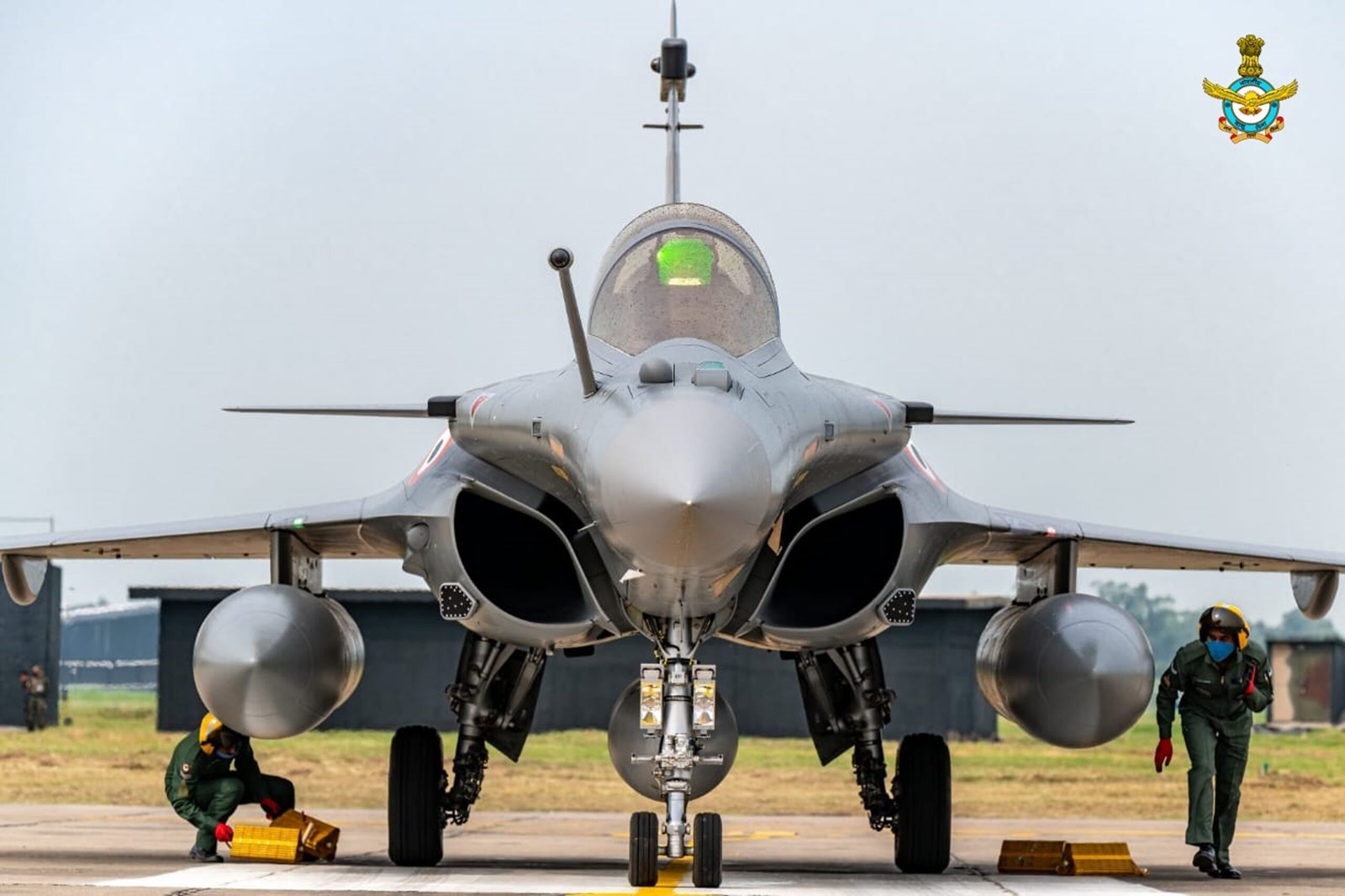
The Rafale’s own strength lies less in any one missile figure than in the combination of its Meteor missile (credibly discussed in the 120–150-plus kilometre class), its AESA radar, and its SPECTRA self-protection suite, which together are built to warn the pilot and disrupt an attack before a shot is ever fired. None of this amounts to a guarantee; the gap between a missile’s maximum range and its realistic killing range against an alert target depends heavily on altitude, speed, and jamming. For deep strikes against fixed targets on the ground, separately, the Rafale carries the SCALP cruise missile at over 300 kilometres, a very different weapon for a very different job, and one that has been carelessly and repeatedly confused with air-to-air combat range in the more excitable corners of the commentary.
The third dispute: an electronic war that neither side can currently prove
Layered atop the missile question is a separate and murkier claim: that Chinese-built radar and missile electronics did not merely rival the Rafale’s defences but defeated them outright. Pakistani and Chinese-sourced accounts have asserted that Indian radar-warning and missile-approach warning systems failed to activate at all during the engagement, and that the PL-15E’s radar seeker resisted Indian jamming and decoys entirely. The Indian and Western counter-account is close to the opposite: that IAF Rafales deployed the X-Guard towed decoy successfully, drawing Pakistani missile locks onto the decoy rather than the aircraft, allowing the jets to exit the engagement zone unharmed. This version has been reinforced by reports that the DRDO recovered and examined a PL-15E fragment after the operation, though even those reports concede that no independent assessment has yet settled what actually happened inside that engagement window. A Western defence analyst has separately dismissed Pakistan’s shoot-down claims on the simplest of grounds: that Islamabad has, to this day, been unable to point to where any downed Rafale actually came down.
This dispute cannot currently be adjudicated by an outside observer, and readers should be wary of anyone who claims otherwise, because a documented information war is running alongside the electronic one. A US Congressional commission report told American lawmakers that China ran a deliberate disinformation campaign after the operation, circulating AI-generated images of fabricated aircraft wreckage through fake accounts, explicitly to damage Rafale’s export prospects in favour of its own J-35 fighter, and Indian officials have separately alleged that Chinese defence attachés lobbied prospective Rafale buyers directly. Beijing has called the charges groundless. Until independent flight-data or debris forensics enter the public domain — something neither Paris, New Delhi, nor Rawalpindi has much incentive to hurry, both the claim that SPECTRA failed and the claim that X-Guard triumphed remain assertions dressed up as fact, and deserve the same scepticism the public eventually learned to apply to the 2016-19 kickback allegations.
The S-400 question: formidable, but not invincible
A further figure in wide circulation, that India’s S-400 system achieved an engagement at over 300 kilometres during the operation, belongs to a third category altogether: ground-based air defence, not a fighter-to-fighter missile duel. It is a genuinely impressive claim if accurate, and broadly consistent with the S-400’s known capability. But it should not be stretched into a claim that Indian airspace is now impenetrable. It is not, and no serious defence planner would say so. The S-400 depends on its own radar horizon, on integration with the wider air command and control network, and on the number of batteries actually deployed along borders running well over 3,000 kilometres with Pakistan and China combined. One successful long-range engagement demonstrates capability; it does not demonstrate universal coverage. What the eighty-eight hours actually showed, once the propaganda on both sides is stripped away, was the value of a networked defence, early-warning aircraft, ground radar, jamming, and layered interceptors working together, rather than any single system winning the day alone.
What follows, then, if the honest verdict is “formidable but not invincible”? Continued investment in the depth and density of long-range air defence along both the western and northern fronts is the first requirement, not a one-time announcement to be filed away as settled. The second is faster progress on indigenous long-range air-to-air missiles, the Astra programme and its successors, so that India is not permanently dependent on imported stocks for its longest-reaching weapon. The third, and the one within the easiest reach of the civilian establishment rather than the armed forces, is a more disciplined public communication doctrine in the opening days of any future exchange, because the vacuum left by official reticence is exactly the space that a hostile and, it must now be said plainly, a somewhat delusional adversary has repeatedly rushed to fill with inflated and shifting claims.
Pakistan’s shifting casualty tallies, its inability to identify where its claimed kills actually crashed, and its evident reliance on a friendly disinformation campaign to salvage the narrative all point to a country that took the heavier punishment in those eighty-eight hours and has spent the year since trying to talk its way out of that fact. The record, examined dispassionately, does not support the version Rawalpindi has been selling.