

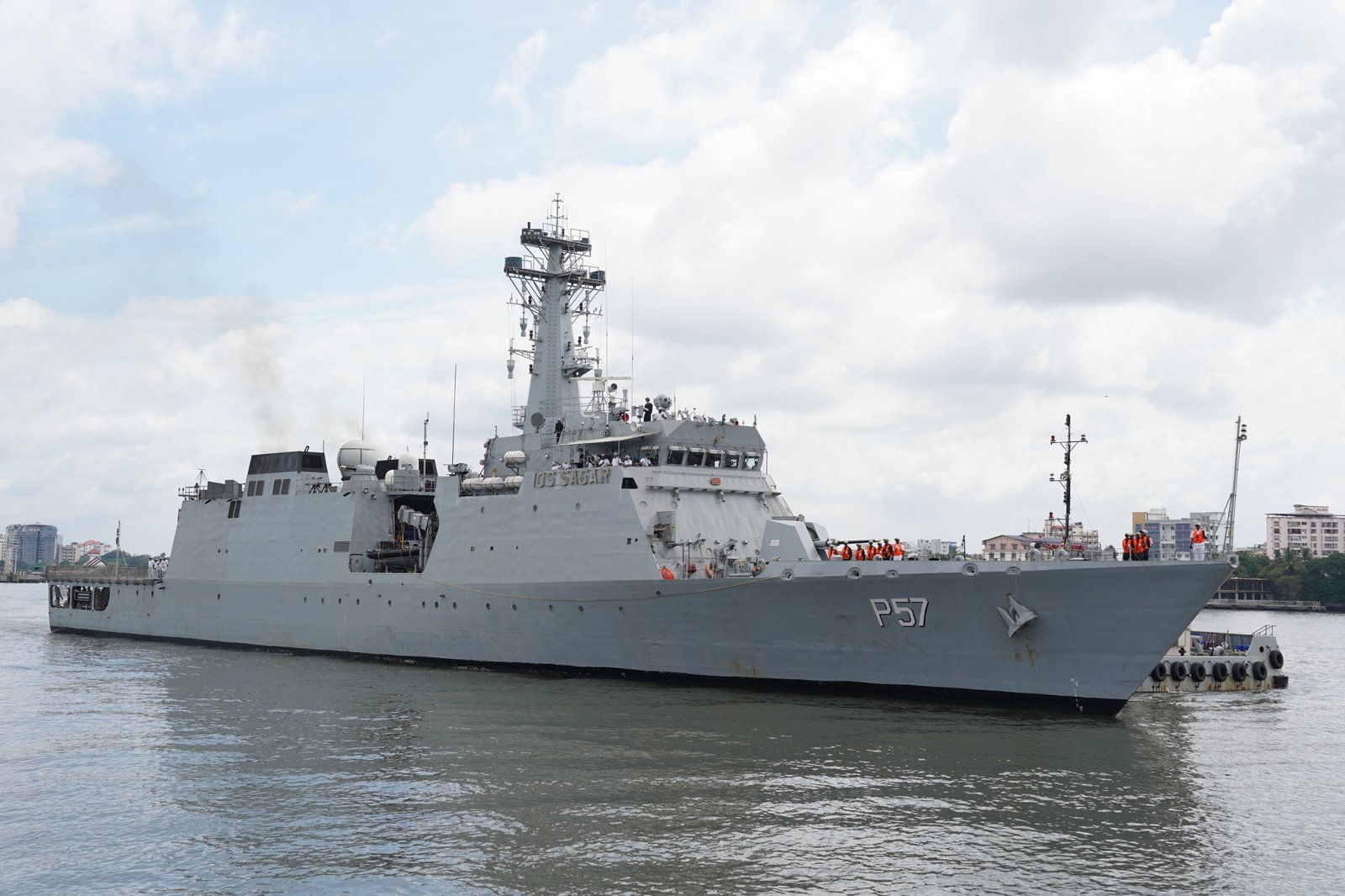
India’s emergence as a ‘net security provider’ in the Indian Ocean Region (IOR) has evolved through a series of strategic initiatives, with the SAGAR doctrine and the Indo-Pacific Oceans Initiative (IPOI) of 2019 representing two of the most significant milestones. India has consistently advocated for an open Indo-Pacific that ensures its strategic autonomy and allows it to engage with the US and China on its own terms.
Strategic and Economic Imperatives
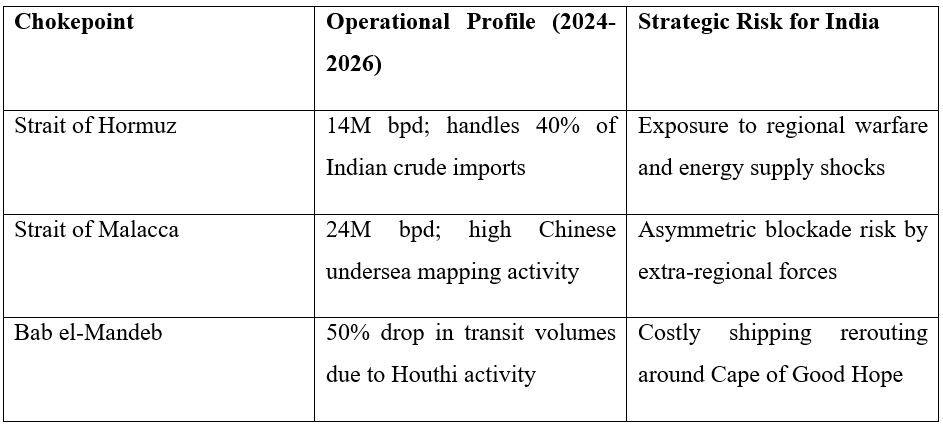
The Indian Ocean is the third largest ocean in the world, and its geopolitical significance drives India to be an active player in the region. It also facilitates a significant portion of India’s foreign trade volume. Furthermore, maritime diplomacy is a crucial part of India’s foreign policy, and its importance is also reflected in India’s energy security. A significant portion of India’s energy imports passes through vulnerable chokepoints like the Strait of Hormuz and the Bab el-Mandeb Suez corridor.
By 2040, India’s demand for oil is projected to double, while demand for natural gas is expected to triple, further underscoring the strategic importance of these maritime routes to the country’s energy security. Along with the protection of its EEZ, the protection of these sea lanes is an integral component of India’s maritime security policy. As geopolitical competition and regional instability continue to intensify, safeguarding these maritime routes has become a top priority of India’s maritime security strategy.
Naval Modernisation and Regional Partnerships
The Indian Navy remains a principal instrument of India’s maritime diplomacy, evolving from a coastal-defence force into one capable of sustaining a persistent, mission-ready presence across its key areas of interest. Its diplomacy operates through a “four Cs” framework: capacity building, capability enhancement, constructive engagement, and collaboration. In February 2026, India made an unprecedented foray into the waters of the Indian Ocean in the form of a naval trifecta in the city of Visakhapatnam- the International Fleet Review, Exercise MILAN 2026 and the Indian Ocean Naval Symposium Conclave of Chiefs, with more than 50 nations participating. India also strengthened its ‘inner circle’ of regional security architecture. The Colombo Security Conclave, which was launched as a trilateral cooperation between India, Sri Lanka and Maldives, has now been expanded to include Mauritius and Bangladesh, with Seychelles becoming its sixth full member at the 7th NSA-level summit in India in late 2025.
Commercially, the Sagarmala Programme has sanctioned 130 projects worth ₹3,714 crore as of mid-2024- modernising port infrastructure and coastal connectivity. India’s parallel shift from a “Buyer’s Navy” to a “Builder’s Navy” is reflected in 54 warships currently under construction with substantial indigenous content.
SAGAR to MAHASAGAR
Launched in Mauritius in 2015 during PM Modi’s visit, SAGAR rests on five propositions: maintaining national and regional security; building maritime cooperation and capacity; promoting institutions such as the Indian Ocean Naval Symposium; supporting sustainable development; and engaging extra-regional partners with a stake in the region. The doctrine is closely intertwined with India’s Act East Policy and its Neighbourhood First Policy, under which India positions itself as a net security provider for littoral and island states. MAHASAGAR broadens this focus to encompass Global South outreach, supply-chain and Blue Economy integration, and a more explicit strategic response to China’s expanding footprint in the Indian Ocean Region.
The Maldives Case Study: A Communication Deficit
India’s maritime statecraft remains vulnerable to domestic political volatility in littoral states. Despite extensive SAGAR-linked infrastructure and security assistance, India’s physical presence has often suffered from a strategic communication deficit. This was evident during the “India Out” campaign against the deployment of Indian military assets and observers in the Maldives. This led to a temporary withdrawal of personnel and the non-renewal of a bilateral hydrographic survey agreement. However, the anti-incumbency sentiment also created an opportunity to recalibrate bilateral relations through pragmatic initiatives, including a ₹4,850 crore line of credit and a renewed Comprehensive Economic and Maritime Security Partnership, while underscoring the importance of complementing maritime security cooperation with proactive public diplomacy.
Recent Challenges
Three developments through 2026 test the durability of India’s maritime gains. First, chokepoint risk has moved from theoretical to acute: on 28 February 2026, Israeli and United States strikes on Iran effectively shuttered the Strait of Hormuz, and a fresh Houthi blockade against Saudi Arabia announced on 20 July 2026 disrupted crude and LNG transit through the Gulf, exposing the Indian Ocean Region as a “bounded ocean” gated by structural, recurring chokepoint vulnerability rather than episodic risk.
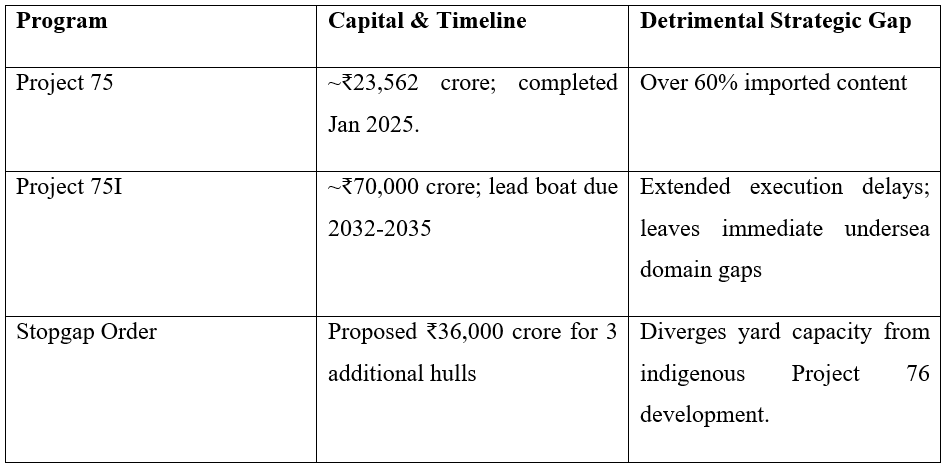
Second, India’s undersea capability gap has widened rather than closed. All six Project 75 Kalvari-class submarines are now in service, but the follow-on Project 75I remains delayed, leaving the Navy without the sustained underwater presence experts say is needed against both Pakistani and Chinese pressure. India’s conventional submarine fleet of 16- with most of them more than 30 years old- is far below the Navy’s requirement of 24 or more. The ₹70,000-crore Project 75I programme awarded to German shipbuilding group Thyssenkrupp Marine Systems got clearance from Finance Ministry on 29 May 2026 but the first of the six submarines would be delivered only by early 2030s, with the final delivery expected by 2038.
Third, efforts towards overland connectivity to lessen India’s reliance on maritime chokepoints have failed to move ahead. In May 2026, the Kaladan Multi-Modal Transit Transport Project, which aims to avoid the vulnerable Siliguri Corridor by connecting Kolkata with Mizoram via Sittwe Port in Myanmar, reached its 300th vessel milestone, but the last stretch of the road from Paletwa to Zorinpui in Myanmar has not been completed yet.
Maritime Diplomacy for a Fair Indo-Pacific
As China’s footprint in the Indian Ocean Region continues to grow, especially with the presence of more research vessels and submarines, Sino-Indian competition is increasing, forcing Delhi to adopt a more comprehensive engagement policy than the traditional security cooperation policy. India’s answer is a combination of Quad cooperation in maritime security and critical technology, rejection of the Belt and Road Initiative corridors traversing disputed areas, and logistics and information-sharing partnerships to enhance operational range. This is based on a self-proclaimed “normative” diplomacy, where India’s Indo-Pacific vision is described as inclusive and rules-based, explicitly with no bias towards any one country, but maintaining strategic autonomy to balance its geopolitical interests with both Washington and Beijing.
Conclusion
India’s maritime diplomacy has matured from a coastal-defence posture into a multi-dimensional strategy spanning naval modernisation, port-led development, and regional partnership. The evolution from SAGAR to MAHASAGAR reflects an ambition to match economic and security tools with China’s expanding regional inroads. Yet 2026 has shown that this ambition is being tested in real time by chokepoint disruptions, a widening submarine gap, and a stalled connectivity corridor, underscoring that sustaining India’s maritime gains will depend as much on closing capability gaps as on diplomacy and partnership-building.


1 Comment
Diksha Sharma
August 10, 2026Lovely and Comprehensive Read!