





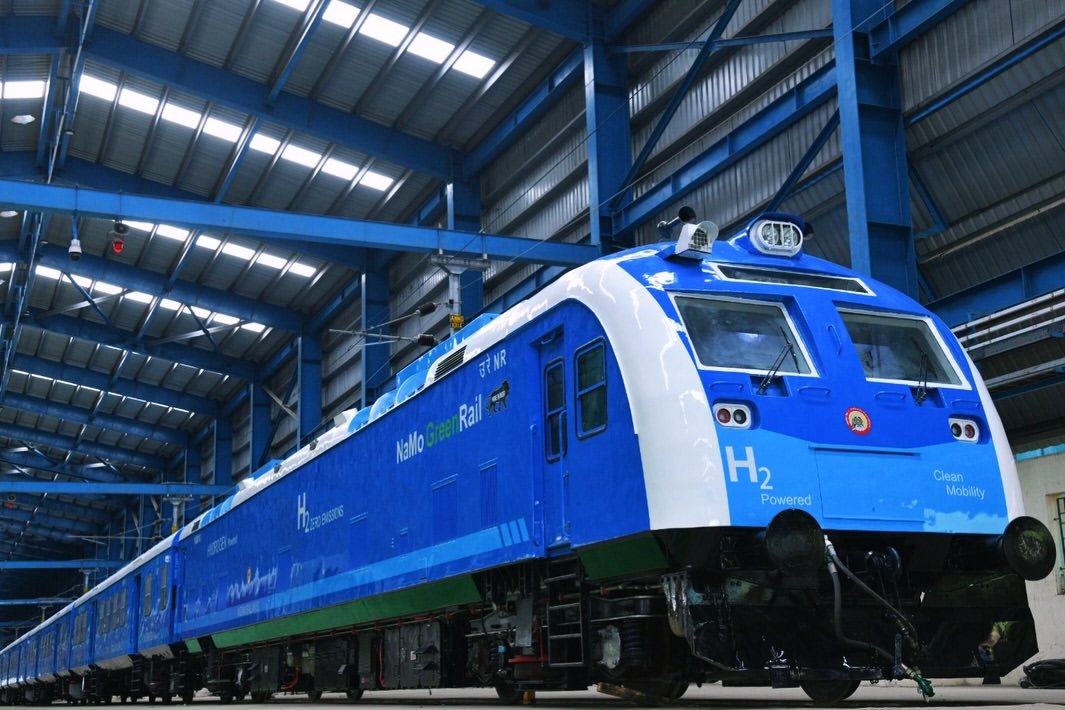
Jind-Sonipat Hydrogen Train a Trailer
The launch of India’s first hydrogen-powered passenger train marks yet another important milestone in the country’s technological and clean-energy ambitions. Inaugurated by Prime Minister Narendra Modi on July 17, the train runs between Jind and Sonipat in Haryana, covering the 89-km route at an operational speed of 75 km/h, with a design speed of 110 km/h. Capable of carrying up to 2,600 passengers, it showcases India’s growing push towards sustainable and indigenous transport technologies.
Recent media reports on India’s first hydrogen train have generated widespread curiosity. Many wonder how hydrogen can power a train, much as earlier generations marvelled at steam locomotives. This is indeed a complex mechanism. Pulling any train requires a powerful engine, and these engines have evolved with newer forms of energy -starting with steam, moving to electricity in 1925, and then to diesel in the 1950s. Today, most trains in India- around 93%- run on electricity, while the rest run on diesel.
Unlike conventional diesel engines, a hydrogen train is essentially an electric train. The difference lies in how electricity is produced. Instead of drawing power from overhead wires, it generates electricity onboard through hydrogen fuel cells- an advanced technology that produces electricity without causing any pollution.
Hydrogen is produced at the trackside through a joint venture between a Spanish and Indian company. The ground storage facility can store 3,000 kg of hydrogen, which is sufficient to fuel the train’s tanks more than ten times. Hydrogen is produced in a water electrolysis plant, which can produce 430 kg of the gas daily. Handling hydrogen is a technologically challenging task as it is stored at 500 bars (500 times the atmospheric pressure) and a very low temperature of minus 17 degrees Celsius. Its storage requires aerospace-grade carbon-fibre storage tanks.
But the real amazing part of the whole system is the hydrogen fuel cells, which generate electricity using hydrogen as a fuel. Hydrogen is passed through a Proton Exchange Membrane which allows only protons to pass through, thus increasing the number of electrons in the hydrogen module. These electrons are free to flow and they generate a current. The flow of electrons in the conductor material like copper cables is what constitutes electricity.
For India’s first hydrogen train, these fuel cells have been acquired from a Canadian firm ‘Ballard Power Systems’. But India has plans to manufacture them on a large scale once the pilot project demonstrates commercial viability.
Currently 93% Indian trains run on electric locomotives. So, many might wonder if electric trains will eventually be replaced by hydrogen trains. This is unlikely soon because the economic efficiency of hydrogen fuel cells remains low, and a lot of research is still needed. The technology holds great promise for the future. Many countries, including India, are vigorously investing in R&D to make it safer, more efficient, and more cost-effective.
India began its research into hydrogen fuel cells as early as the 1970s through academic projects at IIT Madras and Banaras Hindu University (BHU). These initial efforts were followed by targeted initiatives launched at Indian Institute of Science (IISc) Bangalore and various Council of Scientific and Industrial Research (CSIR) laboratories. In 2012, the Indian Space Research Organisation (ISRO), in collaboration with Tata Motors, developed and successfully tested India’s first experimental hydrogen fuel cell-powered bus in Bengaluru. A major milestone was achieved in 2022 with the launch of the first fully indigenous hydrogen fuel cell bus, co-developed by the CSIR and private firm KPIT Limited.
To streamline these technological advancements, the government established the National Green Hydrogen Mission on January 4, 2023. The mission aims to position India as a global leader in green hydrogen production by 2030, targeting an annual capacity of at least 5 million metric tonnes (MMT) and attracting over Rs 8 lakh crore (US$ 95.9 billion) in investments.
The Mission builds upon decades of Indian research. Last year, India also launched its first indigenous hydrogen fuel-cell passenger vessel at Varanasi, demonstrating that hydrogen technology is expanding beyond railways into other transport sectors. Developed by Cochin Shipyard Limited (CSL), the vessel’s commercial service was launched on 11 December 2025 from Namo Ghat in Varanasi. The ultimate objective is to reduce reliance on fossil fuels and successfully transition to a low-carbon economy.
However, it is worth noting that Germany was the global pioneer in this space. As early as September 2018, Germany launched the world’s first commercial hydrogen train service in its Lower Saxony region, following a successful demonstration project two years earlier.
Since then, several nations have accelerated their hydrogen technology development. China has made significant strides in the field. In May last year, it deployed a hydrogen-powered locomotive for commercial freight use in Guizhou province. This locomotive can travel 140 to 150 kilometres on a single 60-kilogram charge of hydrogen and boasts a hauling capacity of over 4,500 tonnes.
While China is undeniably the world’s largest producer and consumer of hydrogen, approximately 77% of its output is ‘grey hydrogen’ derived from a fossil fuel-based process like coal gasification. Currently, green hydrogen accounts for only about 1% to 1.2% of China’s total production. In contrast, the Indian government’s National Green Hydrogen Mission is strictly focused on green hydrogen.
Meanwhile, Western nations are moving at a different pace. The UK is currently in a pilot phase, lagging slightly behind India in terms of commercial-scale implementation. In September 2025, the United States launched its own pilot project, introducing commercial service for a hydrogen train along a 14.5 km Arrow corridor in California. Other nations, including Japan, France, Italy, Sweden, the Netherlands, and Canada, are also running pilot projects with plans to transition to commercial operations soon.
This highlights India’s rapid progress in maturing and deploying these advanced technologies. India plans to launch 35 hydrogen trains, primarily in regions where establishing traditional electrical infrastructure is cost-prohibitive or where the environment is ecologically fragile.
To support this, the government had introduced the “Hydrogen for Heritage” initiative, which aims to run zero-emission trains on historic and scenic hill routes. Indian Railways has budgeted approximately Rs 80 crore per train, with an additional Rs 70 crore required for ground infrastructure along each route.
India’s hydrogen train is still a pilot project, and many technological and economic challenges remain before hydrogen can become a mainstream railway fuel. Yet every major transport revolution begins with a single demonstration. Just as steam locomotives transformed railways in the 19th century and electric traction reshaped them in the 20th, hydrogen propulsion could define the next chapter of railway innovation. Whether that promise is fully realised will depend on sustained research, falling costs and the successful development of a domestic hydrogen ecosystem. For now, India’s first hydrogen passenger train represents an important step in that journey.


1 Comment
Janmesh Jain
July 21, 2026Good news is that the government is thinking of extending this Hydrogen train from Sonipat to Delhi.