




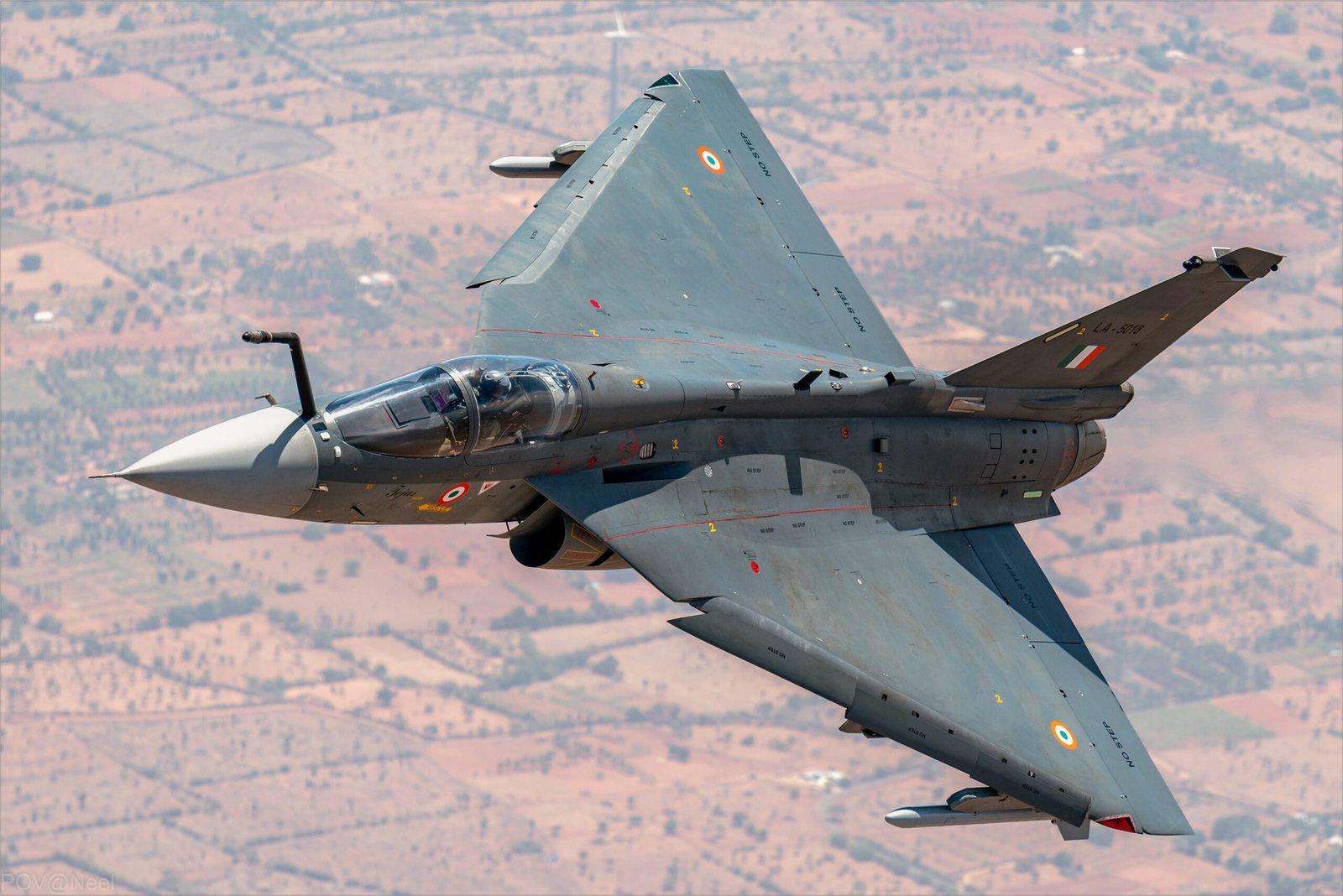
Nearly six years after the first order was placed, the Indian Air Force (IAF) is still awaiting delivery of the first batch of the Light Combat Aircraft Tejas Mk 1A. The Mk 1A is an upgrade over the initial Mk 1 variant, with advanced capabilities such as an Active Electronically Scanned Array (AESA) radar, a modern Electronic Warfare Suite (EWS), mid-air refuelling systems, and the Beyond Visual Range (BVR) missiles. So far, the IAF has placed orders for 180 Mk 1A LCAs with Hindustan Aeronautics Limited (HAL), of which 83 aircrafts were ordered in 2021 and 97 aircrafts in 2025. Former Defence Attache to France Air Vice Marshal H A Rather (Retd) writes on the delays plaguing the project.
There has been a lot of buzz in the media recently about India receiving some F404 engines from the United States and consequently, HAL being able to deliver more Tejas fighters to the Indian Air Force. Most of us would be very excited at the prospect of the IAF finally getting the upgraded Tejas fighter aircraft. However, those of us who have any genuine sense of appreciating facts would not get carried away by the constantly on-roll media telling us what a great achievement it is. We need to remember that IAF is going to get a few more LCA Tejas jets after an excruciating delay of almost three years, and even if we count these, IAF would still be short of 50 aircraft after almost 40-plus years of conceiving the project. While the latest setback was caused by the delay in the supply of F4O4 engines from the United States, we must not forget that this is merely the latest cause in an already much-delayed project. In fact, the project has seen tardy progress in its development for one reason or another, something we cannot thump our chest about.
To put things in perspective, most of the aircraft in the world are conceived, designed and developed in a span of about 15 to 17 years, barring a few exceptions like the F-16, which was even faster. The LCA was conceived in 1984 and inducted into the IAF in 2016- a gap of 32 years since being first conceived. Even after all this time, the IAF was delivered a product which did not meet the original performance requirements. Hence, as a face-saving measure, and to symbolise some national achievement, the IAF was nudged into accepting a version like LCA-Minus, which was then christened ‘LCA Mk-1’, with the promise of getting the desired performance aircraft, later to be christened Mk-1A. In the 10 years since its first induction into service in 2016, we have managed to induct less than 50 aircraft. In comparison, the Chinese have delivered about 500 J-20s in 10 years, something we need to be very conscious of. Our track record on the LCA is something one cannot be very proud of, even with the most astounding nationalist bias in our hearts and minds.
Secondly, what also becomes obvious from the engine delays is the dependence on imports for this otherwise indigenous Tejas. The indigenous content of the much-touted home-grown aircraft is a major embarrassment. Key elements of the aircraft like the aero-engine, radar, weapons and some of the high-tech embedded components, all remain imported. HAL now has orders for almost 200 LCA aircraft. To speed up the production, a second assembly line has been created for the manufacture of LCAs at Nasik. IAF could expect to get these aircraft over the next decade or so, if and only if, we get the F-404 engines from the US. All factors considered, as long as India does not have its own engine (a very niche technology and a critical element of the aircraft), LCA, AMCA or any other fighter in any AVATAAR would be a mirage.
If there is one point on which we can defend the ADA/DRDO regarding the LCA, it is the perspective of combat performance. The LCA “Tejas” was conceived as a replacement for the MiG-21s and not surprisingly, it is indeed a somewhat improved replacement of the MiG-21 aircraft. The LCA, being fundamentally conceived as a “LIGHT” fighter, is, in many aspects, limited in its ground attack weapon carriage and strike performance. The Tejas aircraft (LCA-Mk-I or Mk-IA), in its best avatar or version, would remain best suited for point defence, air defence and close air support of our ground forces, and not for deep low-level strikes or pitched air battles in a modern environment.
Similar is the case with the much-touted AMCA- our 5th generation fighter. ADA/DRDO claims that AMCA will enter production in 2035. Such a claim is seriously misplaced and over-optimistic for any fighter program in the world. It is not possible to achieve such a feat in nine years even when a country has its own well-developed engine technology and an indigenously developed fighter aircraft in operational service. Realistically speaking, even if AMCA enters service in 2040, it would at best be a 5th gen fighter struggling with teething troubles while our adversaries would be flying the 6th gen fighters, like the J-16 or J-36. Whatever the Chinese decide to call it, the point to be noted is- it is already flying and thus already a decade ahead of AMCA.
The combat power of any nation is not perceived in a vacuum; it always needs to be seen vis-à-vis an adversary’s capabilities. Defence preparedness is a deterrence and a threat only if it is potent and effective in time and space. The combat air power scenario that is emerging looks like this. While India continues to face delays in the LCA project, LCA Mk-II is nowhere to be seen, AMCA is still on the drawing board, and our adversaries are rapidly moving ahead in the quality and quantity of air power they possess and building mostly between themselves.
While DRDO/ADA do have some achievements to their credit, airpower and aerospace technologies are a totally different beast to master. In the case of airworthy high-tech equipment, the level of technology required for a product to perform in the harsh and dynamic environment of the medium of air and in the constrained space of fighter aircraft is another mountain to be scaled.
Our primary research and development organisation has time and again failed to meet the IAF’s operational requirements, both in terms of capability and adherence to delivery schedules. Project completion is repeatedly delayed and eventually, the government is forced to go for procurement of high quality contemporarily relevant weapon systems from abroad to maintain the required fighting parity with our adversaries. A clear example is the recent procurement of 26 Rafale Marines from France for the Navy, in spite of the Twin-Engined Deck-Based Fighter (TEDBF) program of the DRDO. CCS approval for procuring 114 additional Rafales from France is another example.
There can never be any doubts about the importance of self-reliance and the merits of indigenous manufacture of defence products. No doubt the defence forces would be delighted to use an indigenous weapons system, but in warfare, what matters most is the weapon that you wield when you need it, and not the origin of the weapon. This frustration of the armed forces was evident when our present IAF Chief was seen venting his frustration with HAL on the delays in LCA deliveries in a recently viral clip.
For the last 50 years or so, the armed forces have only seen unkept promises by DRDO and the country has been forced into distress purchases from foreign vendors. Our political leaders have, for too long, been swayed into colossal funding of projects due to the false promises made by DRDO/HAL. Eventually, more funds are pumped in simply to recover the earlier ones. If the country’s defence parity with our adversaries is to be maintained, we cannot continue with more of the same or maintain an ever-positive rhetoric of an Atmanirbhar Bharat. We need to stop and take stock. We not only need to change, we also need to overhaul our approach to the indigenous development of high-tech weapon systems.
In most of our complex indigenous projects where the nation commits thousands of crores, DRDO has been unable to deliver the required product, of the desired performance and quality, within the stipulated time and LCA is a prime example. Encouraging our scientists to grow is one thing but producing a weapon system of the most contemporary technology and capability in time, is totally another. You cannot land with your self-made car that simply runs, when you are competing in a Formula-1 race. You are bound to lose even before the start. In warfare, where there are no prizes for second place, a nation cannot afford such indulgence. The LCA story is a saga; one that is far from pretty. However, there is a lot to learn there. We must learn from the LCA experience, and review the functioning and accountability of DRDO, lest we are doomed to repeat our failures.