




Where the Mediterranean Meets the Arabian Sea
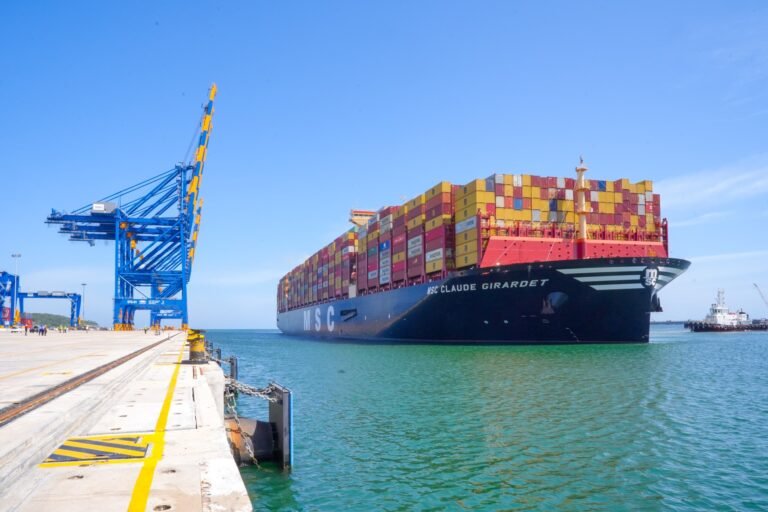
Adani Ports and Special Economic Zone Ltd has just agreed to sell 49 per cent of its Vizhinjam port subsidiary to Mediterranean Shipping Company’s terminal arm for about 1.4 billion dollars, valuing the project at roughly 2.85 billion dollars and instantly creating the largest single foreign private investment in India’s port infrastructure. Mediterranean Shipping Company, a privately held, Switzerland‑based giant that has grown into the world’s largest container shipping line with a vast global network of box ships and terminals, is not just any investor; it is the very company whose vessels and containers already stitch together major trade routes across five continents. In one stroke, Vizhinjam has moved from being a controversial state‑level public-private partnership, dogged by protests and delays, to a showcase of India’s supposed prowess in attracting deep‑pocketed global capital into strategic infrastructure. The politics and political economy of how we arrived here, however, are far more layered than the celebratory headlines suggest.
The 1.4‑Billion‑Dollar Berth
For MSC, the world’s largest container shipping line, this deal converts a customer relationship into co‑ownership of a deep‑draft transhipment hub at the very tip of the Indian peninsula, hugging the main East-West shipping lane. Instead of relying on contracts and goodwill alone, MSC will now hold equity, board representation and long‑term capacity rights in an Indian Ocean gateway that could, if all goes to plan, divert containers from Colombo and other foreign hubs. For Adani Ports, the transaction monetises a large greenfield bet, brings in an “anchor customer” as strategic partner, and frees up capital while retaining 51 per cent and management control. In corporate terms, therefore, this is a classic win‑win: risk‑sharing, network consolidation, and a stronger grip over the flow of boxes through the northern Indian Ocean. But when you step back from the spreadsheets and look at who prepared the ground, who bore the early risks, and who now harvests the premium, a more familiar Indian story emerges, of public money, private power and foreign capital converging on the coastline.
Kerala’s Left at a Capitalist Harbour
To understand Vizhinjam today, we have to loop back a decade, to Vizhinjam yesterday. This is, fundamentally, a Kerala project. The concession was awarded in 2015 by a Congress‑led state government to the Adani Group, at a time when the idea of a private conglomerate running a major port on Kerala’s coast was already controversial. When the Left Democratic Front returned to power, it inherited a signed contract, a partly mobilised project, and a sharpened political narrative that painted the port as a textbook case of “crony capitalism”. The LDF chose continuity, with modifications, over cancellation. That was not an ideological conversion so much as an acceptance of political economy constraints. By then, the state had committed substantial public spending on land, breakwaters, and external infrastructure; the sunk costs were real, both financially and reputationally.
The government’s room for manoeuvre lay at the margins: renegotiating timelines, imposing penalties for delays, tightening some performance clauses, and talking up long‑term benefits in terms of jobs, coastal development and Kerala’s claim to “world‑class” infrastructure. All this happened against the backdrop of sustained opposition from fishing communities, sections of the Church, and environmental groups worried about shoreline erosion, displacement and inadequate rehabilitation. The same Left that rails against corporate capture in Delhi found itself policing agitations in Thiruvananthapuram’s fishing hamlets, arguing that without a huge port, Kerala would “miss the bus” in the global logistics race. It is this uneasy compromise, between ideological discomfort and fiscal compulsion, that now provides the platform for the MSC cheque.
Delhi’s National Champions at Sea
If Kerala’s narrative has been one of reluctant embrace, the Union government’s story is one of deliberate design. For over a decade, New Delhi has nudged India’s port sector away from public‑sector “port trusts” towards landlord‑style models operated by private players. The current dispensation has taken that shift further, actively backing a small cluster of large conglomerates as “national champions” across ports, airports, power and logistics. Adani Ports is the emblematic beneficiary of this approach. In that vision, the MSC–Adani tie‑up is almost textbook success. A private Indian operator builds and runs a strategic asset; global capital validates the asset with a large dollar bet; and India edges closer to its stated goal of becoming a transhipment hub rather than a feeder to Colombo and Singapore.
Fold in the Indo‑Pacific narrative, concern over Chinese footprints from Hambantota to Gwadar, talk of resilient supply chains and trusted corridors, and Vizhinjam fits neatly into the script. A deep‑water hub on India’s own coastline, co‑owned by the world’s largest liner, helps New Delhi argue that key sea lanes in the northern Indian Ocean can be serviced from Indian soil rather than from ports under varying degrees of Chinese influence. It is not a military facility, but in the Indo‑Pacific imagination, reliable commercial hubs are part of the same chessboard: they shape routing choices, port dependence, and the everyday geography of sea power. The irony is that a Left‑ruled state government and a BJP‑led Centre, usually at loggerheads, are now structurally aligned at Vizhinjam. Both need the project to “succeed”: Kerala, to justify its fiscal outlays and political capital; the Centre, to showcase its reforms, its embrace of private champions, and its maritime ambitions. Once MSC joins this coalition as a co‑owner, the bloc in favour of expansion becomes formidable. In that setting, regulatory independence, environmental safeguards and labour rights become questions not just of law, but of political courage.
When FDI Follows the Breakwater
There is an understandable temptation to treat the 1.4‑billion‑dollar figure as self‑evidently good. In a country that still worries about the current account, foreign exchange stability and the infrastructure gap, a single‑asset inflow of this magnitude looks like a macroeconomic gift. It will feature in PowerPoint decks in Delhi, in state‑government speeches in Thiruvananthapuram, and in Adani investor presentations in Mumbai and Geneva. But it matters what kind of FDI we are talking about, and at what point in the risk cycle it arrives. This is not greenfield industrial investment in a backward district, nor a technology‑rich manufacturing joint venture. It is foreign equity flowing into a special purpose vehicle whose underlying risk has already been significantly underwritten by Indian public funds and regulatory decisions.
The physical asset, the breakwater, dredging and land, has been put in place with a heavy public hand. The private developer has indeed taken risk, but with contractual cushions; the state and Centre have borne political and social costs. When foreign capital comes in at this stage, it is effectively buying into a de‑risked asset whose value has been co‑created by taxpayers, local communities and domestic capital. The FDI statistic records the inflow; it does not record who carried the early‑stage burden, or how the future rent‑stream will be shared. If this model becomes the norm, public money and social patience upfront; foreign capital and private equity payouts once success is visible, we will have engineered a sophisticated form of public‑to‑private value transfer while congratulating ourselves on “attracting FDI”. That does not make the deal undesirable. It does mean that FDI headlines should be read with a more sceptical eye.
Fishermen at the End of the Queue
The people who live by the sea see Vizhinjam very differently from those who model it in Excel. For fishing communities along this stretch of the Kerala coast, the port has meant years of uncertainty about erosion, changed currents, access to traditional fishing grounds, and the adequacy of compensation and rehabilitation. When protests escalated, the state used both persuasion and the police to keep the project on track. The moral authority of a Left government insisting that “development” demanded sacrifice did not always carry as far as the breakwaters. For them, the arrival of MSC as co‑owner will be read less as vindication and more as closure. Once a Swiss shipping giant, a politically powerful Indian conglomerate, a fiscally stretched state government and a central government keen on FDI all align, the space for reopening basic questions shrinks dramatically.
Disputes are then confined to the margins: how much compensation, in which colony, with what kind of resettlement package, rather than the core issue of whether the coastline should be re‑engineered on this scale at all. There is a broader democratic concern here. Sovereigns like to present marquee foreign investments as proof of credibility. But those same investments then harden the project’s political armour: backing out or even significantly altering course becomes reputationally costly. Global capital, in that sense, does not just bring money; it also brings a kind of discipline to domestic politics. The communities most affected often find that by the time the dollars land, the room for bargaining has narrowed to almost nothing.
Ports, Power and the Politics of Control
None of this is to deny the very real gains Vizhinjam can bring. A well‑run transhipment hub at India’s southern tip, with adequate hinterland connectivity, can reduce dependence on foreign ports, lower logistics costs, and anchor new maritime services and jobs. It can serve as a strategic counterweight in an Indian Ocean crowded with external powers, and give India greater leverage in any future crisis that disrupts conventional routes via Colombo or the Malacca Straits. Those are tangible, national‑interest benefits. The structural question, however, is about the architecture of control. When a strategic port is owned by a state‑level SPV, operated and majority‑controlled by a single private conglomerate, and partially co‑owned by a foreign liner company, with both state and central governments politically invested in its success, who ultimately decides what happens when interests diverge?
What if commercial imperatives at the terminal clash with labour rights, environmental red lines, or national security preferences, for instance, routing decisions in a time of regional tension, or access for particular flag states? Are our concession agreements, regulatory institutions and competition law frameworks robust enough to arbitrate those tensions, or do they quietly assume that what is good for the operator is good for the country? Vizhinjam, with its 1.4‑billion‑dollar FDI badge and Indo‑Pacific relevance, brings these questions into unusually sharp focus. On paper, it looks like a four‑way triumph: Kerala as maritime hub, Delhi as reformer, Adani as global infrastructure player, MSC as savvy long‑term investor. In political‑economy terms, it also signals the kind of coastal future we are drifting towards—where public expenditure and social patience build the runway, and a combination of domestic and foreign corporate power controls the aircraft.
A Chronicle from the Breakwater
As someone who has watched India’s infrastructure story from the inside of government and the outside of commentary, I cannot look at the MSC-Adani deal only through the lens of numbers. Yes, 1.4 billion dollars is a serious cheque. Yes, a functioning Vizhinjam will mark a strategic and logistical milestone, and modestly rebalance the Indo‑Pacific map in India’s favour. But an honest chronicle must also record who stood in the water when the first stones were laid; who signed the concession when it was politically risky; who carried the agitations and their policing; and who now sits across a polished boardroom table to negotiate valuations in foreign currency. India does need ports like Vizhinjam if it is to integrate more deeply into global trade. The question is what institutional arrangements, regulatory guardrails and political cultures we build around them.
Do we want a coastline dominated by a few “national champions” partnered with global majors, with the state as guarantor and the citizen as spectator? Or can we imagine a more plural, accountable model, still efficient, still attractive to capital, but less prone to concentration and capture? Vizhinjam does not answer these questions; it poses them with unusual clarity. As we welcome MSC’s dollars and Adani’s expanding footprint, we would do well to remember that the real test of a port is not just how many containers pass through it, or how prominently it features on Indo‑Pacific maps, but how fairly the benefits and burdens of its existence are distributed. That, ultimately, is the chronicle that will matter long after the FDI and “strategic hub” headlines have faded.