



The recent admission by the Indo-Tibetan Border Police (ITBP) chief about continuing face-offs between Indian and Chinese forces has confirmed a fact widely known but rarely acknowledged. Despite appearances of a thaw in bilateral relations, China and India need to do much more to build mutual trust. Dr Srikanth Kondapalli, Professor in Chinese Studies at Jawaharlal Nehru University, analyses the impact of recent developments on the Indo-China relationship.
On October 23, the chief of Indo-Tibetan Border Police (ITBP) Shatrujeet Singh Kapoor stated that several border face-offs were happening across the undefined borders with China and that Shaurya platoons are deployed to counter them.
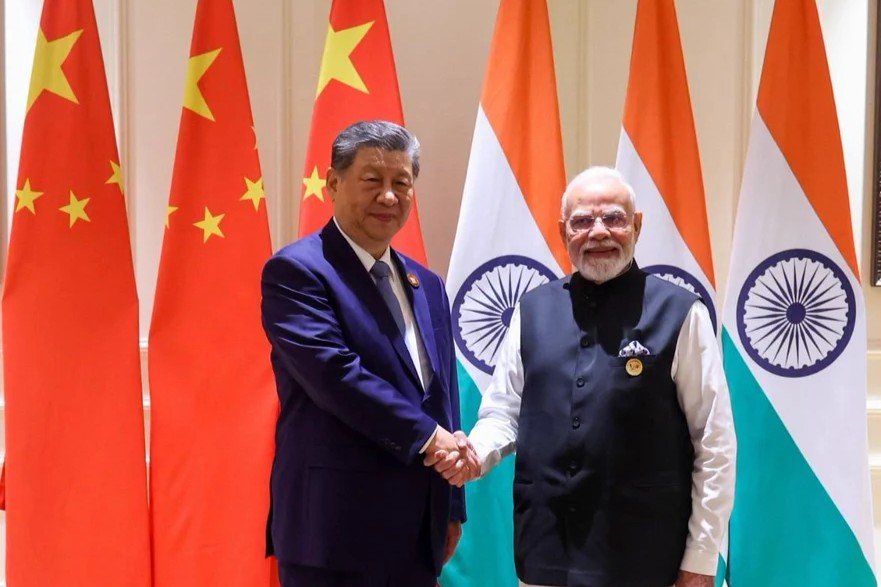
This statement comes in the wake of two other major developments such as the recent meeting between Indian Prime Minister Narendra Modi and China’s President Xi Jinping on September 12, on the sidelines of the 18th BRICS Summit meeting at New Delhi. This meeting signalled a potential thaw in bilateral relations after the bloody border conflict at Galwan in Eastern Ladakh in June 2020.
A second development is related to reports of China’s military transgressions in Taksing area of Upper Subansri District of Arunachal Pradesh in the eastern sector of the boundary. In the 1962 border clashes with India, China’s army had occupied Longju area on the McMahon Line and had recently built a “well-off society” village – one of over 628 such villages constructed across borders with India, Nepal and Bhutan. It was reported that China’s army had conducted “salami slicing” of Indian territories intruding a few kilometres and were allegedly obstructing locals from accessing their traditional habitats and religious places.
The above reports attest to the continuing uncertainty on the undefined Line of Actual Control (LAC) between the two countries despite a series of border management measures and efforts by the political leaderships to find an amicable solution to the problems.
At the political level, following the Kazan BRICS meeting between the two leaders in Russia in October 2024, a broader dialogue began about the bilateral relations which had taken a nosedive after the border clashes at Galwan on June 15, 2020. The Kazan meeting, and a Corps Commanders meeting two days before this, resulted in dis-engagement of troops in Eastern Ladakh areas and commencement of patrolling. However, de-escalation of military equipment and de-induction of fresh troops did not materialise, thus suggesting limited progress on the borders.
From disengagement to delimitation
Since August 2025, three Special Representative (SR) talks have been held between National Security Advisor Ajit Doval and China’s foreign minister Wang Yi – in December 2024, August 2025 and August 2026. At the 24th SR talks, a ten-point consensus on the boundary issue was arrived at whereby an Expert Group would explore “early harvest” of boundary delimitation, a Working Group would advance effective border management and Corps Commanders meetings in all the three sectors of the border would discuss issues. In addition, they decided to re-open the three border trading posts closed after the 2020 clashes. The 25th SR talks held recently mentioned an “Early and Substantial Harvest” of boundary delimitation and border management, in addition to opening two additional channels of border military hotline in the Eastern and Middle Sectors.
These are substantial from an institutionalisation perspective and to the emerging “management of the border”. When the SR talks began in 2005, it had three phases of talks to “define the LAC”. Recent talks suggested “delimitation” of the boundary. The next phase, in general, is “demarcation” of the boundary in its logical extension. Since the talks are classified, it is not clear about the progress on defining the LAC, its delimitation and demarcation processes.
Also, not the entire 3,488 km long LAC is in dispute. More than three decades of talks between the two officials have reduced the number of areas of dispute. For instance, the current disputed areas in the Eastern sector include Longju, Asaphila, Namka Chu, Samdurong Chu and Chantze, in the Middle sector- Kauril, Shipki and Barahoti, while in the Western sector- Pangong Tso, Trig Heights, Samar Lungpa, Demchok, Chushul, Depsang Bulge and recently, China has started claiming Chumar area as well.
Such talks between the two sides should bring in stability in the bilateral relations. While officially, India characterises the India-China border as “stable, yet sensitive”, the Chinese side calls it “generally stable”. However, the prevalence of border transgressions indicates that peace and tranquillity on the border remain a distant dream.
China’s expanding territorial claims
To add trouble to the bilateral relations and to the border areas, China had announced on January 12 that it had incorporated permanently Kashmir lands at Sakshgam that Pakistan had transferred in March 1963. To follow up, a few days after President Xi returned to Beijing from the New Delhi BRICS summit visit, China and Pakistan formally launched a Joint Boundary Commission meeting at Islamabad on September 16-17. All of these actions are in violation of their own bilateral joint statement of March 1963 and indicate the firming up of China’s mind on occupied Kashmir areas. This is not a coincidence as China raised the Kashmir issue in “informal talks” at the UN Security Council three times in 2019 and 2020, but failed to muster strength from the other Permanent 4 members. In December 2024, China divided the disputed territory in the western sector, Aksai Chin into two counties He’an and Hekang, for expanding its administrative machinery and for the eventual expansion of its military and paramilitary paraphernalia to the region. Further, China renamed 112 places in Arunachal Pradesh six times- in 2017, 2021, 2023, 2024, 2025 and recently, on April 10, 2026.
Infrastructure as a strategic weapon
Another additional factor of concern on the borders is the breakneck speed with which China is building dual-use infrastructure projects in Tibet and Xinjiang. While it built the Aksai Chin highway in 1953-57, today, it has more than 1,20,000 km of roads in Tibet with G219, G318 and G349 highways crisscrossing from western Xinjiang, Tibet and reaching Chengdu in the east, improving military logistics across the LAC areas. China built the Gormud to Lhasa railway in 2006 and is now constructing one from Sichuan to Lhasa passing through Nyingchi prefecture opposite Arunachal Pradesh. China also has 37 airports with 22 designated for dual-use. Apart from laying down fibre-optic cables, China has built 624 “well-off society villages” across the LAC.
Thus, the continuing transgressions on the border, additional claims by China, and its consolidation of Kashmir territories transferred by Pakistan in 1963, infrastructure development and renaming of places in Arunachal Pradesh – all signify Chinese thrusts in the region, underscoring the role of armed forces in protecting India’s territorial integrity and sovereignty.
At the military and para-military level, both sides have stood their ground. However, the Indian side has indicated that they could stand up more firmly to any Chinese machinations on the border altering the status quo. The fact that it took more than four years from Galwan clashes to the Kazan meeting between the leaders to make attempts at normalisation indicate that this time, India succeeded in stalling the Chinese juggernaut on the border.
India’s military preparedness
The Indian Army deployments against China have been strengthened further with additional troops, military equipment, infrastructure projects and allocations. Today, Indian Army has five Corps for operations across the LAC, while the Indian Air Force is modernizing its 82 military air bases for operational readiness, specifically Hashimara, Tezpur, Chhabua, Bagdogra, Leh, Mudh-Nyoma, Daulat Beg Oldi, Kargil, Thoise and others. The Indian Air Force also began deploying Su-30, Rafale and other fighter aircraft for air superiority functions besides enhancing cyber security. India’s naval forces, while playing a marginal role to the continental disputes with China, play an indirect role in exerting pressure on Beijing, given the latter’s dependence on sea lanes of communications in the Indian Ocean.
The frontline force, of course is the nearly 90,000-strong ITBP raised during the 1962 border clashes with China. It has 173 Border Out Posts in the three border sectors- 71 in Himachal and Uttaranchal, 67 in Sikkim and Arunachal Pradesh and in Ladakh, about 35.
India’s infrastructure development along the borders is increasing at pace in the last decade. The India-China Border Roads (ICBR) project that began in 1999 with a plan to construct 73 strategic roads is bearing results now. About 44 strategic roads were inaugurated in October 2020. Two crucial projects – the 13 km Sela Tunnel, bringing in much-needed connectivity between Guwahati and Tawang was completed in March 2024 and the 1,700 km Frontier Highway (NH 913) connecting Bomdila to Vijaynagar in Arunachal is scheduled to be completed this year. In addition, a 4G Saturation programme with 20,000 4G telecom towers constructed in 30,000 border villages was completed by July 2024. Also, a Vibrant Village Programme began in February 2023 in 19 districts and 2963 villages across the LAC for repopulating the villages with citizens who left for urban areas in the past decades.
Even though China’s Western Theatre Command has been beefed up in the operations following Galwan clashes, it is grappling with corruption cases and other disciplinary violations. As a result, many of its commanders and political commissars including Zhao Zongqi, Wang Haijiang, Li Fengbiao and Yin Hongxing have either been arrested or are facing reprisals.
Trade ties amidst strategic distrust
A third dimension of the bilateral relations is the increase in trade in recent times. Although this aspect of commerce is relatively marginal to the bordering areas, it is significantly changing the bilateral dynamics. Bilateral trade reached $155 billion (with a trade deficit of $116 billion in favour of China) in 2025. However, border trade is negligible given the post Galwan freeze and the seasonal nature of opening of the border trading posts. For instance, in Uttarakhand, the border trade through Dharchula was estimated at nearly $158,000 this season. With India diversifying to sign free trade agreements with nearly 36 countries and refusing to be part of the China-dominated Regional Comprehensive Economic Partnership, the economic dimension of bilateral relations is also experiencing structural differences.
Thus, in the three dimensions – political, military and economic – of the bilateral relations, India-China relations are witnessing subtle challenges despite recent signals for normalisation. The unresolved boundary issue is still negatively influencing the bilateral relations, with severe negative consequences for India and China.