
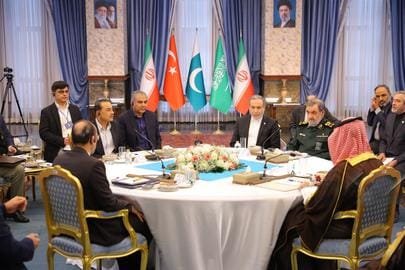
Pakistan has recently expanded its diplomatic engagement in West Asia, leveraging its Islamic identity to strengthen its position as a diplomatic and security partner. The Mecca Defence Agreement with Saudi Arabia and Turkey, alongside Pakistan’s efforts to facilitate dialogue between Saudi Arabia and Iran, reflects its growing role as a diplomatic bridge in the region. The recent high-level meeting in Tehran further illustrates how Pakistan is seeking to translate its shared Islamic identity into greater regional influence and international standing. In this article, Gandhi Riyang, an independent researcher examines why Islamic identity remains central to Pakistan’s foreign policy, how Islamabad has historically sought to leverage it for diplomatic influence, and the limitations of this approach
To explore the Islamic identity of Pakistan, one needs to go back to the circumstances that led to the creation of Pakistan. These include the efforts of the Muslim League during the British Raj to secure a separate homeland, driven by the perception that the emerging political order would be dominated by the Hindu majority, and the assertion that Muslims constituted a distinct national identity rather than merely a religious minority. The result was a bloody partition that divided the Indian subcontinent into India and Pakistan, the latter being a nation built on the idea of a “two-nation theory”; as such, it was a nation-state solely built on a Muslim religious identity. Such conceptualisation of identity, where the axis mundi also happens to be Islam, dictates not only the domestic policy choices but also the foreign policy choices of Pakistan. Most recently, the signing of the Mecca Pact, which has been dubbed the “Islamic NATO”, shows the use of Islam by Pakistan to gather support for foreign policy goals on the world stage.
Pan-Islamism, Nuclear Ambitions, and Pakistan’s Quest for Status
Pakistan found itself in a strategic geopolitical location after independence and its identity as a non-Arab Muslim country solidified its neutral status; thus, it chose to support Pan-Islamism and was vocal about the decolonisation of Muslim states in the Levant and North Africa to bolster its identity as a Muslim nation.
Pakistan’s quest to create an identity separate from India in a region where it lived under its dominating shadow, and the fact that international obligations of the Raj would go to the newly independent India and thus enable its direct admission to the United Nations, meant that Pakistan had to exert itself in securing its status as a new state and nation. As Islam and a Muslim identity were the pillars of Pakistan’s new national identity, it became an important priority in Pakistan to create a united front among the Ummah (Community of Muslim believers), and as such, Pakistan was promoting Pan-Islamism through the 1950s via conferences such as the World Congress of Muslims in Karachi in 1949 as well as the International Islamic Economic Conference again in Karachi in 1949.
Pan-Islamism, unfortunately, did not get the traction that Pakistan was hoping for; the dominant form of social organisation in the region was ethnic and not religious, in contrast to Pakistan which had fought under a Muslim identity. Further, with West Asia being embroiled in its own internal and regional struggles, it was clear to the Pakistanis who were promoting the ideals of Pan-Islamism and a Muslim bloc that these were not resonating with the Muslim countries of West Asia, who did not incline toward these ideals.
The other arena that showcased the use of an Islamic identity by Pakistan was the building of Pakistan’s nuclear capabilities, the development of which was intrinsically tied to the archenemy in the region- India. The Indian nuclear test came in 1974, which was followed by Pakistan developing its own nuclear capacity; by 1998, Pakistan tested its nuclear bomb, and thus raised its expectation to be recognised as a pre-eminent Muslim power. Zulfikar Ali Bhutto, who had started the nuclear programme in Pakistan in the year 1972, had advocated for a bomb for the Islamic civilisation- an “Islamic Bomb”- to get funds from wealthy Muslim nations. Yet, rivalry among various Muslim countries prevented the maintenance of long-lasting alliances, and thus the Islamic Bomb was not a straightforward affair in this sense.
The Use of Islamic Identity
Pakistan has repeatedly invoked its Islamic identity to gain diplomatic currency. Bhutto, a champion of Pan-Islamism, had a close personal bond with King Faisal of Saudi Arabia. At the Organisation of Islamic Cooperation (OIC) Summit in Lahore in 1974, where Sheikh Mujib-ur-Rahman was present with the help of the Muslim heads of state who brought Mujib to the Lahore Summit, Pakistan not only absorbed the shock of 1971, but the Pakistani leadership also welcomed him. The takeover by General Zia ul-Haq from Bhutto in 1977 led to the ‘Islamisation’ of Pakistani society. In the 1980s, Zia used Islam as a strategic asset back home as well as abroad. Even as Saudi Arabia and Iran were using Islam to advance their strategic interests, Pakistan still stuck to the idea of Islamic brotherhood that transcended nationality. Even today, Pakistan maintains a close relationship with Saudi Arabia, one that carries a distinct religious dimension.
Such an identity has been employed against India. The Kashmir issue has long been used by Pakistan at the Organisation of Islamic Cooperation (OIC) as a Muslim cause. In October 2026, the OIC foreign ministers’ meeting in Baghdad backed Kashmiri self-determination and the rejection of India’s abrogation of Article 370; India responded that Pakistan was misusing the OIC platform for such a bigoted agenda.
The Mecca Joint Defence Agreement, signed by Saudi Arabia, Turkey and Pakistan on 7 August 2026, extends this pattern. The pact is a build-up on the Saudi-Pakistan agreement of September 2025, and it means that an armed attack on one would be considered an attack on all. Pakistan’s defence minister urged other Muslim states to join, and Shehbaz Sharif put the pact on a course against India, invoking the May 2025 conflict. Indian analysts have expressed caution against such an arrangement, viewing it as a path that will encourage Pakistan to act more aggressively. But the collective is weaker than what the cable suggests. First, it lacks a joint command or shared assets; analysts further cite divergent interests within this bloc and weak mutual defence capacity; and, lastly, it is unlikely that Saudi Arabia will adopt Pakistan’s stance toward India.
Conclusion
Pakistan has long used its Islamic identity as a foreign policy tool, from Bhutto’s Lahore Summit and the development of its nuclear programme to the recent Mecca Pact. This approach has helped Pakistan secure funding, partnerships, and diplomatic influence in its rivalry with India, often beyond what its material capabilities would otherwise allow. However, its success has depended on whether other Muslim states’ interests align with Pakistan’s. History demonstrates these limitations: Pakistan’s Pan-Islamic ambitions gained little traction in the 1950s, external support for its nuclear programme failed to produce lasting alliances, and the Mecca Pact lacks a joint military command. Ultimately, religious identity may open diplomatic doors, but national interests determine the extent of cooperation.