



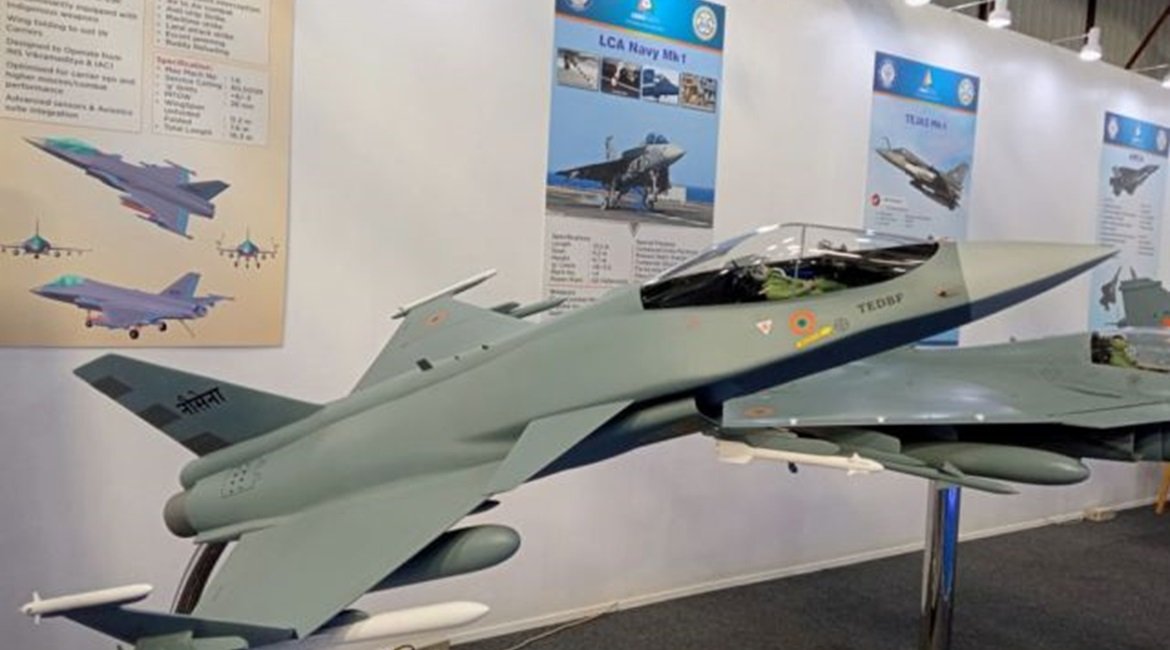
Amid reports of the Twin Engine Deck Based Fighter (TEDBF) being developed as a Drone Command Hub for carrier battle groups, it appears the programme has evolved beyond a clearly defined naval requirement. With repeated timeline slippages, the Indian Navy’s turn towards the Rafale-M, and India’s limited requirement for carrier-based fighters, questions remain whether continuing the programme can still be justified on strategic, operational or economic grounds. Air Vice Marshal H. A. Rather (Retd) examines these concerns and the case for reassessing the programme.
I came across an article in a well-known defence portal recently which claimed that “TEDBF is being developed as Drone Command hub for carrier battle groups from the very beginning.” The author might have missed that the TEDBF was conceived in 2018/2019 and announced by DRDO/ADA in April 2020. Later, the Indian Navy (IN) decided to go for global procurement of a carrier-based fighter in 2022 owing to pressing operational needs. However, an article in Feb 2023 claimed that TEDBF is undergoing major design changes. So, while one portal claims that TEDBF was being conceived as a Drone Command Hub from the very beginning of the programme, another one claims that the TEDBF programme saw the need for a major design change in 2023 (in less than four years). This calls for well-informed subject matter experts to set the record straight.
The TEDBF is a typical example of how DRDO/ADA have been pursuing projects as mostly engineering experiments and engagement avenues for their ever-growing staff, unmindful of the changing operational or strategic relevance of the project with the passage of time. The fact that they rarely deliver what is sought by the armed forces or even what they promise themselves at the sanction stage of a project, almost becomes irrelevant to the continuation or shelving of the project. The project remains alive in our predictable, non-controversial realm of defence production with the granting of extensions and concessions time and again. DRDO continues to keep even supposedly redundant projects alive under the pretence of delivering something contemporary of global standards sometime soon and indeed, locally in India, at much lower costs. Most of those promises are either white lies or half-truths, sometimes deliberately overlooked and swallowed by the decision makers as a bitter pill.
Shifting timelines
The TEDBF program is an outcome of the refusal by the Indian Navy to accept the naval version of the Tejas, LCA-N. Here’s a look at the timeline:
April 2003 – The Cabinet Committee on Security (CCS) first sanctioned development of LCA for the Navy.
July 2010 – India unveiled its first naval variant of Light Combat Aircraft (LCA) Tejas. At the time, it was said, “we are confident that ADA-HAL will make NP-1 (trainer) ready for the first flight in six months (end of 2010), and NP-2 (fighter) next year.”
Apr 2012 – The naval prototype (NP-1) of the country’s Light Combat Aircraft (LCA) took its maiden flight, almost two years after roll out of the programme.
Dec 2016– Indian Navy opted out of the LCA programme completely, saying the naval variant was ‘overweight’ and a single engine did not suit naval requirements.
2018 – The stalled LCA-N programme was interestingly revived, and the flight tests were resumed on NP-1 and NP-2, specifically for attaining technological maturity for the ultimate naval carrier-based fighter, a twin-engined fighter.
2019 – It was accepted that the Qualitative Requirements (QR) of the naval fighter were still being prepared by the Indian Navy. Nevertheless, DRDO announced that the aircraft would be ready by 2026.
April 2020 – DRDO officially announced the development of the Twin Engine Deck Based Fighter (TEDBF) with induction into the IN slated by 2032.
Jun 2025 – DRDO chairman said that TEDBF could be ready by 2038.
The above timeline shows a PDC slippage of 1.5 years from 2010 to 2012 for an aircraft whose clone had been flying for 15 years. Now, the PDC for the TEDBF which was given as 2032 has changed to 2038, a slippage of 6 years.
The cost of delays
Putting this in perspective, the naval variant of Tejas was supposed to replace the ageing Sea Harrier fleet and the Indian Navy was said to have made an initial commitment for 50 Tejas aircrafts, given that the platform proved its mettle. The Indian Navy paid 40% share of the development cost. Then, to maintain some air arm on the carrier, the Indian Navy had to go for MiG-29Ks from Russia after the Sea Harriers were phased out. Now, when the MiG-29Ks are about to be phased out, the Indian Navy has had to resort to global procurement. It has opted for 57 Rafales from France, of which only 26 have been sanctioned for now.
Having procured the proven naval platform Rafale-M, which will last us another 40 years, the logical choice would be to have another 26-30 aircraft of the same type which will meet the Indian Navy’s carrier-based aircraft requirement for the next 40-50 years.
However, that logical choice would render the TEDBF project meaningless and so, DRDO/ADA has changed tunes and is now claiming to develop TEDBF as a Drone Command hub spearheading offensive counter-air (OCA) missions and a Combat Air Teaming System (CATS) controller.
From a pure developmental perspective, it would be a miracle if the supposed TEDBF gets off the drawing board and takes to air on the land-based ski-facility, forget about an operational version ready to go to battle from a carrier by 2035.
In 2016, 21 years after the LCA’s first flight, DRDO/ADA could only manage to deliver an LCA which fell short of what the IAF had asked for three decades back. And now, we are expected to believe that a TEDBF- whose first fibre-glass mock-up was displayed in 2021, whose engine is non-existent for now and whose first flight is nowhere on the horizon- will be inducted in the next nine years. Even if one believes in miracles, this is asking for too much.
To me, it appears to be a continuous drive to somehow keep projects running under one pretext or other while making unrealistic and false promises to the leadership and bureaucracy. The latter, unfortunately, either have little or limited techno engineering evaluation capability or little or limited incentives or interest in applying it to stop the mindless expenditure of taxpayers’ money on projects like the TEDBF.
Indigenous Development Needs Strategic Priorities
Now let us look at the matter from a planning and strategy perspective. The argument that the TEDBF is being developed to nurture indigenous technological growth does not hold water. DRDO has abundant opportunity and scope to display indigenous technological growth on the IAF aircraft projects that they have at hand. Importantly, DRDO has not been able to deliver all the technical specifications that the Indian Air Force wants on its aircraft. So, where is the need to diversify and pick up another project for the Indian Navy? I do not subscribe to the view that in order to encourage and build in-house technology, DRDO must be allowed to do numerous projects at the same time. I would argue that rather than taking on too many projects and delivering on none, it is better to pick a few on which they could focus their time and energy and maybe get somewhere.
When industry invests money into R&D, it does so with a view to beat its competitor in price or performance or both. First and foremost, there must be need for development. The numbers should justify the investment into the research and development for that project. DRDO’s desire to develop a carrier-based aircraft should stem from India’s own need for a certain number of carrier-based aircraft or a highly likely and viable export opportunity.
Let’s examine who we can export an India-developed carrier-based fighter to. As of today, there are only five other countries in the world- the United States, Russia, France, the United Kingdom, and China- that have chosen to acquire and maintain aircraft carriers on their inventory. All these countries have a very advanced and mature aircraft industry, so export to these countries is ruled out. Obviously, we can make deck-based fighters or carrier-based fighters only for our own consumption- for the Indian Navy.
Programme without a viable future
Now let us assess as to how many aircraft the Indian Navy actually needs. At best, India will have two aircraft carriers. Even if we have three, at any given time, we will have only two aircraft carriers which will be sea-worthy- one for the Arabian Sea and the other for the Bay of Bengal. The best fighter aircraft carriage capability of our aircraft carriers is 16 to 20 aircraft. So, our requirement cannot exceed 40 carrier-based fighters. Considering a 20% reserve, the number would climb to 48 or 50.
The Indian Navy had sought 57 carrier-based fighters (I would settle at 52 to be more realistic). We have already bought 26. The remaining 26 or so aircraft should logically be of the same type for a host of reasons. It will not be sensible to operate two different types of aircraft for two deployable carriers ignoring huge advantages of inventory similarity from maintenance, training and deployment perspectives. Eventually, because of expected delays on the promised TEDBF by DRDO, or operational compulsions or possible production of IAF Rafales in India, it is likely we will go for 26 more Rafale-Ms, which would suffice for the next 40 to 50 years.
Therefore, it is clear, we don’t need to make a TEDBF or ORCA (another fancy christening by DRDO to keep the project alive) for India ‘s own defence requirements for the next 40 years at least. Remember, India does not have a jet engine of its own, so we cannot expect to export a jet fighter to almost anybody, in competition with the original engine manufacturing country. There is no scope of exporting a twin-engined deck-based fighter to the five countries that own aircraft carriers.
So, why should India be investing so much time, money and energy into a project with almost no meaningful purpose? Such futile investment of taxpayers’ money should be avoided at all costs. I see no reason in trying to continue with projects which make no sense strategically or from an industrial perspective. It would have been a different matter if DRDO was ahead of the curve, had already achieved all that was sought for land-based fighters by the IAF and now wanted to explore and master the added challenges of the carrier-based version. Let us first learn to walk and then think of running. DRDO must be made accountable for all its indulgences and for a start, the TEDBF project must be shelved forthwith.