




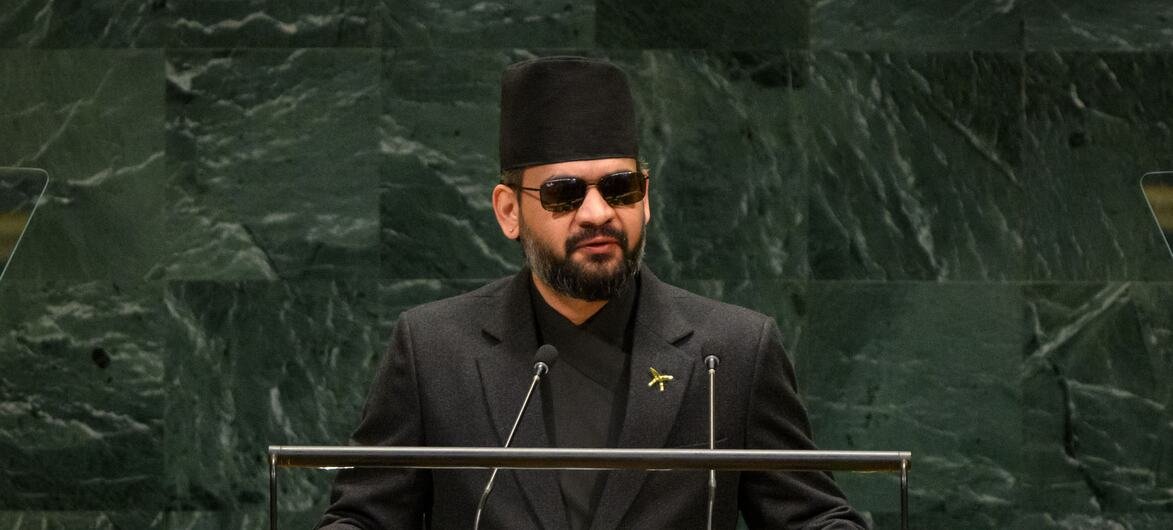
Nepal’s Prime Minister Balendra Shah’s speech at the 81st UNGA has earned him praise at home for raising Nepal’s climate vulnerabilities. It was focused and sharp, highlighting Nepal’s independent stand on ecological disasters that had hit the country recently. PM Shah called it a warning to the world, where the political leadership has ignored the scientific studies and the voices of people and communities on climate disasters and continued with development projects. Others, however, critiqued the speech as rhetorical and lacking specifics.
The Bhote-Koshi Catastrophe
The background of the speech was set on the catastrophic glacial burst, floods, and landslide in the Bhote-Koshi river in the Rasuwa district of Nepal on August 26 this year. Rasuwagadhi is the border town of Nepal neighbouring Gyirong in Tibet region of China, which has been used by locals for centuries for movement of people and goods. In 2014, it was developed as a border point and formal trade route between the two countries. After the Kodari border point in Sindhupalchowk district was damaged due to earthquake and landslide in 2015, Rasuwagadhi became the primary trade route. There is a road link from Rasuwagadhi to Kathmandu, and China has completed a feasibility study on the proposed railway link from Shigatse to Kathmandu via Rasuwa, as part of its Belt and Road Initiative.
Due to the increase in traffic, an economy had begun to develop in Rasuwa. Small businesses had emerged. Dhunche, the administrative headquarters of Rasuwa district, was becoming larger and more vibrant with an increase in business. The glacial burst, along with a massive landslide of water and debris, devastated the border point and downstream areas along the Bhotekoshi and Trishuli river systems. PM Shah informed the UNGA that nearly 1400 people had died and 6000 people are still missing.
The newly formed government of PM Balendra Shah came to power in March 2026, following massive protests popularly known as the Gen Z movement. It is notable that the average age of Members of Parliament in the new government formed by the Rastriya Swatantra Party is less than 43 years, and PM Shah himself is 36 years old. Shah, however, did not want to highlight the fact that he was the youngest head of state to address the UNGA this year, but rather focused on the cause which he was espousing.
Government’s Response
The new government, with practically no prior experience of governing, had the immense responsibility of handling an emergency like situation thrust upon them. The young leadership in Nepal acted with courage and resilience, calling upon the armed forces for rescue operations and accepting assistance from immediate neighbours, India and China. Initially, it did not open its doors to other countries willing to assist, as Nepal had faced coordination problems with foreign countries and agencies that had arrived in Nepal for rescue and search operations after the 2015 earthquake. Later, Nepal allowed a limited number of experts in search and rescue, especially from those countries whose citizens were missing. India, China, Australia and South Korea were allowed to send experts for tunnel rescues and DNA/ forensic examination. While expressing gratitude to those who helped Nepal in its hour of crisis, Shah did not want charity but insisted on `shared responsibility and solidarity.’ He did not project Nepal as the only victim of climate change in the Himalayas, but mentioned the region from Hindu-Kush to the eastern Himalayas as a victim of ecological disasters and climate change that were not of their own making.
Development paradox in the fragile Himalayas
It has been noted with concern by the environmentalists, geologists and other experts that the young and fragile Himalayan ecosystem is increasingly affected by indiscriminate construction of buildings, roads, tourism, hydro-power dams. Incidents of cloud bursts, landslides, glacial lake outburst, have increased. While climate change is a slow evolutionary process, man-made activities have hastened it. By bringing ecological disaster under the framework of climate change, the focus shifts from faulty development paradigm to a natural phenomenon. One such example is the rush for Hydro-power projects. They are known to have not only displaced people from their habitats, but also reported to have been raising temperatures during summers and increased fog in winters. Geologists have been warning about glacial retreat, such as in Gangotri, but tourism in the Char Dham goes unabated. Often these warnings are brought within anti-development paradigm or security interests of a country. The need of the hour is to bring in people-centric sustainable development projects.
One successful model for environmentally friendly `high value, low volume’ tourism is Bhutan in the region. It charges Sustainable Development Fee from the tourists; Indian tourists pay IRs 1200 per night, and those from other nationalities pay $200, which has been reduced to $100 till August 31, 2027. Being a small country with a population of around 800,000, it is easy to dismiss the scale of its development burden, but other Himalayan countries can certainly learn best practices and adapt them according to their own requirements, such as increasing forest cover like Bhutan or limiting tourist footfall based on the carrying capacity. This would mean looking for alternative means of employment for locals, which is the need of the hour.
While search operations for flood victims were going on, the Nepal government was projecting the country as safe for tourists. Culture, Tourism and Civil Aviation Minister Khadak Raj Paudel communicated in a video message on Facebook under the hashtag ‘#NepalCalling’ that trekking routes were open and that tourist visits would help Nepal meet the challenges posed by the natural calamity. It meant that the trekking routes were unaffected by the floods and landslide. Foreign Minister Shishir Khanal informed the diplomats and development partners based in Nepal that the disaster was geographically localised. Celebrities like Manisha Koirala urged international tourists to visit Nepal as it would help the livelihood of the locals. Yet, heavy rainfall has continued in recent days, and on September 27, an avalanche hit Himlung, Himal Peak in Manang district, killing 4 and leaving 12 missing. This raises the question- are the young, fragile Himalayan ranges safe for tourists during the monsoon season?
Shared Responsibility
Climate disasters know no political boundaries, and this is especially true for Nepal, a mountainous country that shares borders only with India and China. Both neighbours are industrial economies and have their own share of carbon emissions, whereas Nepal, as per Shah’s submission, contributes only 0.6% of the total emissions. Instead of blaming his neighbours for the negative impact of their development trajectories, Shah talked of shared anxieties and responsibilities.
Shah reminded the UN of its `agreed principle of common but differentiated responsibilities and respective capabilities’, that those who have contributed more to carbon emissions or climatic changes must bear a greater burden of mitigation. He also spoke about grant-based approach to climate finance rather than loans. These suggestions would still be a cosmetic approach for managing disasters rather than addressing the basic question of why natural disasters are occurring more frequently in the Himalayas and what trajectory should be followed for environment-friendly development. Shah proposed cooperation among Nepal, India and China on satellite data sharing, monitoring of glacial lakes, early warning systems and coordinated cross-border assistance, including the establishment of a Himalayan Climate Resilience Mechanism led by the three countries. The International Centre for Integrated Mountain Development (ICIMOD), based in Nepal, already exists as a knowledge hub for conservation and sustainable mountain development with eight regional members from Hindu-Kush Himalayan region, including Nepal, India, China. However, its recommendations are not binding on member states. ICIMOD is supporting the Kanchenjunga Landscape Initiative and Development Project, which brings together India, Nepal and Bhutan for biodiversity conservation and sustainable development. BBIN is another sub-grouping involving Bangladesh, Bhutan, Nepal and the Northeastern states of India for economic cooperation. Similarly, Nepal, Bhutan and the Himalayan states of India could form a sub-regional grouping for economic and environmental cooperation.