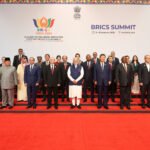

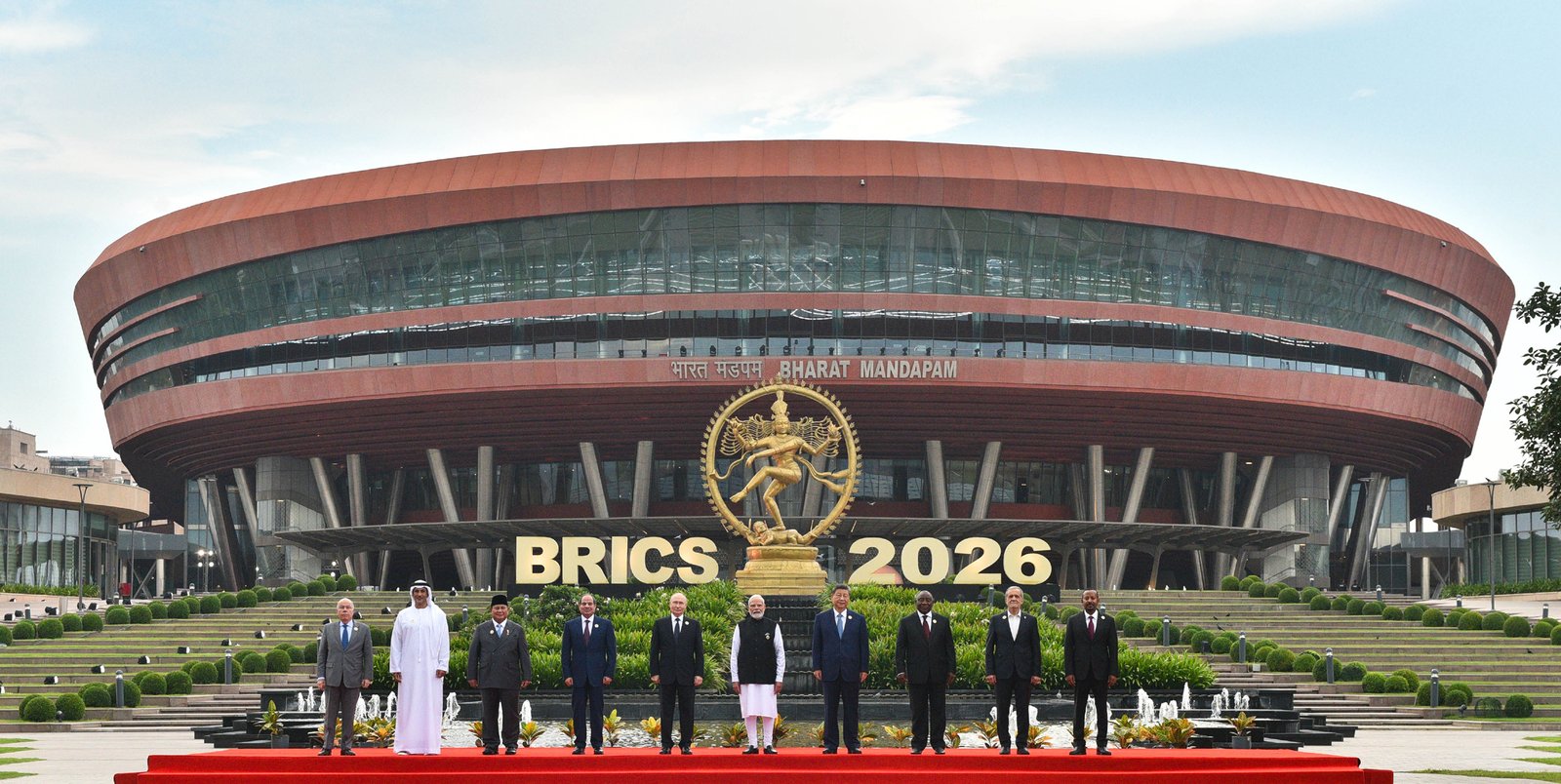
The 18th BRICS summit has concluded amid a slew of agreements. New Delhi was teeming with activity as heads of states from 11 member states, partner countries and other dignitaries attended the two-day meet. As the dust settles, assessments have begun. Did BRICS deliver? Did India deliver? This in turn leads us to the question – what did BRICS 2026 set out to do in the first place? Prof Bhaswati Sarkar, Jean Monnet Chair, Centre for European Studies, School of International Studies, JNU, analyses.
The Consensus
For the 18th summit, Prime Mister Narendra Modi’s proposal to redefine BRICS as “Building Resilience and Innovation for Cooperation and Sustainability” reflects India’s thinking on what would be a fitting role for the group in a rapidly changing environment of technological change. BRICS works on consensus but the relation members share with each other bilaterally, their strategic interests, are more often than not complex and make consensus building challenging. In May this year, the foreign ministers failed to reach consensus. All eyes were therefore on the Summit meeting. The question was whether India could repeat its G20 success and come up with a declaration. And India, under the leadership of PM Modi, delivered once again. A 140-point resolution was adopted. This is no mean feat given that the expanded BRICS of today has four members embroiled in two deadly wars in Ukraine and West Asia. New Delhi succeeded in the role of a bridge builder that it took upon itself.
The optics of the event was significant, with the presence of leaders like Chinese President Xi Jinping, Russian President Vladimir Putin, Iranian President Masoud Pezeshkian and Abu Dhabi Crown Prince Mohamed bin Zayed Al Nahyan, among others. The final resolution relates to – Inclusive Global Governance and Strengthening Multilateralism; International and Regional Peace and Security; Strengthening Cultural & People-to-People Cooperation. A look at the Factsheet on Outcomes and Initiatives shows a wide array of areas that BRICS members have committed to work on.
Action Areas
The Factsheet lists around 50 identified areas on which the BRICS members are committed to work. India has previously chaired BRICS in 2012, 2016 and 2021. The Chairship, on each occasion, mirrored the priorities and challenges of its respective period. In 2026 too, much work went before the summit to identify areas of interest and possible cooperation. Over 350 meetings and high-level engagements were held across 25 Indian cities. A pretty exhaustive list of areas has been identified – agriculture, health, anti-drug, corruption, skilling, innovation, startups, energy, urban infrastructure, disaster risk reduction, education, counter-terrorism, taxation.
New Initiatives
A number of new bodies have been launched – BRICS CONNECT for Skilling, BRICS Digital Centre of Excellence for Smart Grids and Energy Storage, BRICS Urban Mobility Hub, BRICS MSME Cooperation Portal, BRICS Startup Innovation Fund, BRICS Science and Research Repository, BRICS Logistics Supply-Chain Cooperation Framework, BRICS Centres of Excellence on Agro-Ecology, BRICS Network on Digital Agriculture, BRICS Guidelines for Disaster Management Early Warning Data Integration. How these different initiatives will work and deliver remains to be seen.
One important proposal that India tabled is the BRICS Continuity and Implementation Mechanism. Much like the trio in the Council of the European Union, the idea is that a troika of outgoing, current and incoming chairs will work to “ensure systematic follow-up on all initiatives and outcomes”. How this will operate remains to be seen, but given the wide gamut of areas that BRICS is committed to work on, this proposed mechanism would help assess progress and challenges and assist recalibration.
Areas of Continued Focus
All BRICS members have been subjected to unilateral tariffs imposed by President Trump, who threatened further tariffs if the group attempted de-dollarisation. In a world of escalating geopolitical competition, weaponization of tariffs and sanctions, BRICS has become more relevant. Overall, the BRICS steered clear of openly taking an anti-US/Western position, but the members reaffirmed their commitment to use national currencies in trade with each other and also enhance intra-BRICS trade.
Over the years, India has repeatedly highlighted the menace of terrorism that it faces and Pakistan’s role in it, at various platforms. BRICS has been no exception. For India, the 2026 resolution is significant. The Resolution not only strongly condemns “any acts of terrorism as criminal and unjustifiable, regardless of their motivation, whenever, wherever and by whomsoever committed” but also condemns “in the strongest terms the terrorist attack in Jammu and Kashmir on 22 April 2025, during which 26 people were killed and many more injured.”
Bilateral Meetings
Apart from this, the BRICS summit provided an opportunity for important bilateral meetings on the sidelines – India’s meetings with Russia, China, Iran and that of Iran with Saudi Arabia. With Russia, the bilateral meeting was an opportunity to renew and strengthen relations. Energy, defence, trade- the traditional areas of our engagement were once again the focus of discussion. In the bilateral meeting with Iran, following in the footsteps of the SCO meeting, the leaders exchanged views on recent developments in West Asia. Prime Minister Modi appreciated Iran’s participation in trying circumstances and reiterated India’s consistent position that dialogue and diplomacy are the only way forward in resolving all issues. Modi also emphasized the importance of lasting peace and stability in the region and the need to ensure freedom of navigation and commerce, and the safety and well-being of seafarers.
The bilateral meeting between PM Modi and President Xi was perhaps the most important event on the sidelines of BRICS 2026. India and China are the two largest economies in the group and their cooperation or lack of it will impact the capacity and relevance of the group. Relations between the two had hit an all-time low in 2020 after the Galwan Valley clash. Over the past two years, the relations are on the mend, with the two leaders having met in Kazan in 2024 and in Tianjin in 2025. This was President Xi’s first visit to India after seven years, he had given the G20 meeting in 2023 a miss. Areas of mutual interest – trade, business, supply chains, people-to-people exchanges were discussed. Border continues to be the most sensitive issue. PM Modi reiterated the importance of peace and tranquillity along the border for continued development of bilateral relations. He also emphasized on a relation based on mutual respect, mutual interest and mutual sensitivity. Xi, on his part, emphasized that the two countries should approach their relationship with a broader strategic outlook.
BRICS 2026 has provided yet another opportunity for the countries to stay engaged and not allow differences to become disputes. The road ahead will not be easy. There is already an attempt by Pakistan to rake up the boundary issue with a meeting of Pakistan-China Boundary Joint Commission in Islamabad. The Ministry of External Affairs came out with a statement categorically denying the existence of a boundary between Pakistan and China and said that the Commission exists “without any legal basis.”
Conclusion
A group is as powerful as their members want it to be. The BRICS of today is a grouping of consequence. It now accounts for around 40 per cent of global GDP and 49.5 per cent of the world’s population. Merchandise exports from BRICS countries to the world rose from about $900 billion in 2003 to nearly $6 trillion in 2024. The group’s share of global exports, in other words, increased from about 12 per cent to nearly 24 per cent. Yet, as PM Modi rightly pointed out, in the pyramid that represents the current international order their voice is near absent. This anomaly must be addressed. Governance based on “pyramid of privilege” has to make way for “platform of partnership”. What we witnessed at the New Delhi summit is a step towards that partnership. Differences and frictions notwithstanding, the eleven members chose to stand together and identify areas where cooperation is possible and collaborative action is the best solution. The commitment of all members will now be tested as the grouping now moves from resolution to action.