




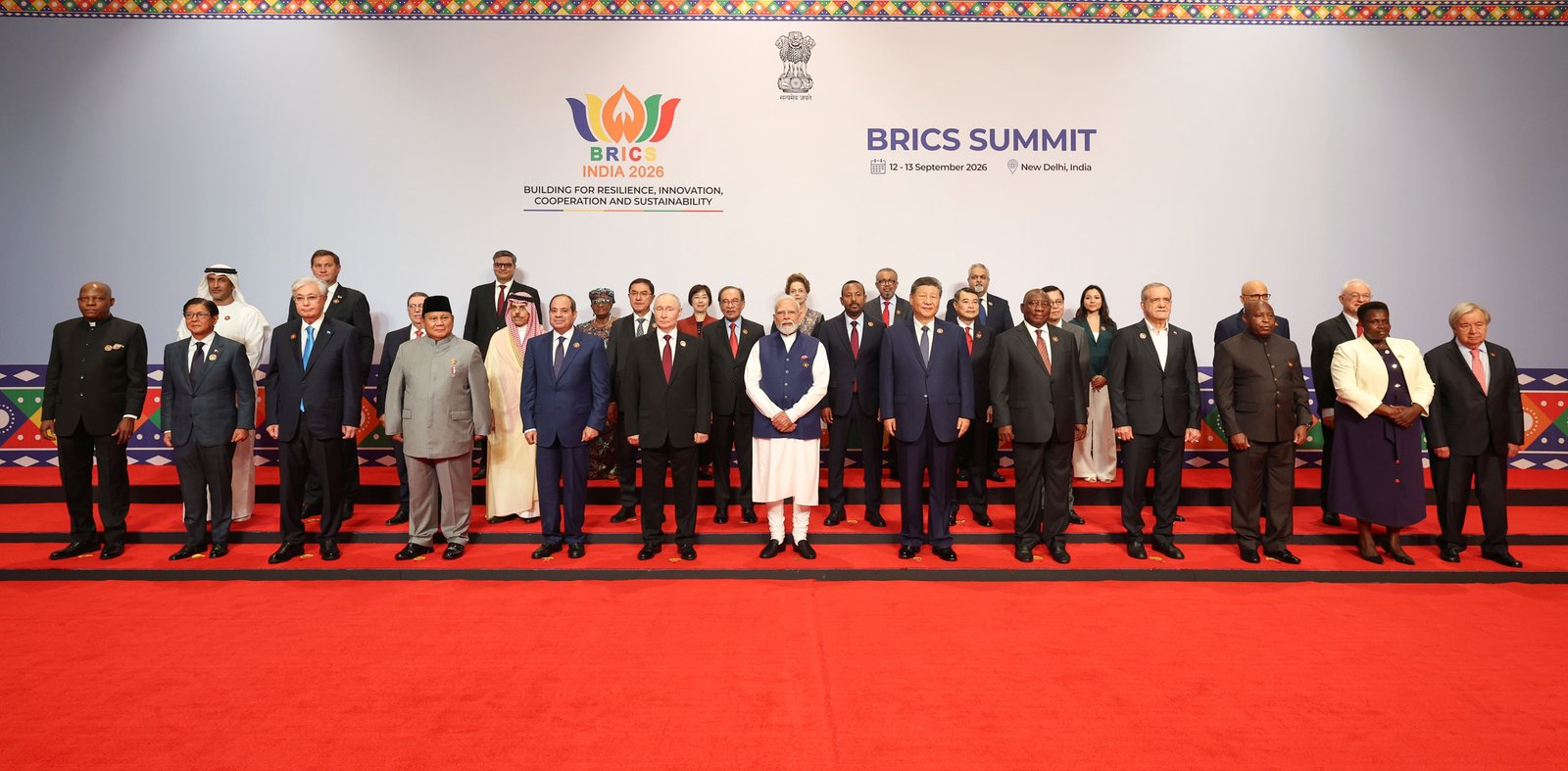
By all accounts, the 18th BRICS summit hosted by India from 12 to 13 September 2026 was successful in more respects than one. Apart from taking a firm stance against unilateral coercive measures running contrary to international law, the declaration signed by the grouping of 11 countries laid significant emphasis on the growing role of emerging high-end technologies in both economic and social development. It highlighted a clear resolve to enhance cooperation among BRICS nations in the fields of innovation and technology. This collective effort will undoubtedly ensure sustained economic and social progress in an increasingly techno-competitive global landscape.
The declaration highlighted an urgent need for the peaceful use of outer space and space systems, while aiming to reduce existing asymmetries in space capabilities among member states. Ironically, just two days after the summit declaration underscored this, the United States announced that it had fielded weapons capable of both offensive and defensive nature. This drew sharp reactions from China and Russia, both of them warning that it would trigger a dangerous arms race and turn Earth’s orbit into a warzone.
It is worth recalling that the heads of space agencies within the BRICS grouping had previously met in Bengaluru to emphasize the importance of cooperation in space science. During that meeting, they had decided to expand data-sharing mechanisms, facilitating the exchange of high-resolution imagery between their respective agencies- India’s ISRO, China’s CNSA, Russia’s Roscosmos, Brazil’s AEB, and South Africa’s SANSA. The bloc decided on the terms for a joint Space Council to coordinate outer space traffic management, planetary research, and climate-monitoring satellites. Member states also reaffirmed their commitment to space debris mitigation to ensure the long-term sustainability of outer space activities.
Not space alone, attention was accorded to the full spectrum of Science, Technology, and Innovation (STI) declaring them key drivers of sustainable socio-economic growth. To this end, a BRICS Science and Research Repository has been envisioned as a structured platform for voluntary knowledge storage and sharing, to be operated in accordance with national laws while strictly respecting data security, intellectual property rights, and relevant domestic policies. Cooperation will also expand into emerging spheres like quantum technologies.
However, it remains to be seen how quickly the BRICS Global Research Advanced Infrastructure Network (GRAIN) Centres will be established and become fully operational. To support these initiatives, the BRICS Incubator Network has been set up, and a BRICS Startup Innovation Fund is under active consideration as a potential mechanism to catalyse innovation-led growth.
AI AT THE FOREFRONT
The issue of Artificial Intelligence (AI) and its global governance remained at the forefront of the deliberations. Acknowledging AI’s potential to stimulate economic growth and sustainable development, the summit considered enhancing the accessibility of AI resources of paramount importance. Amid debate on potential risks among AI leaders, the development of trustworthy AI technologies was deemed essential for an equitable and prosperous future for all countries, particularly those in the Global South.
AI-led Industry 4.0 became yet another important theme of the summit. Historically, many developing countries had participated inequitably in earlier industrial revolutions- from steam-powered mechanisation in the late 18th century, electricity-driven mass production in the early 20th century to the computer, IT, and robotics-based automation in the late 20th century.
Now, at the dawn of the fourth industrial revolution (Industry 4.0), disparities in technology access remain glaringly evident. BRICS took a step in the right direction by planning effective cooperation systems to ensure universal participation in this ongoing revolution. This collaboration will be championed under the Partnership on New Industrial Revolution (Part-NIR).
Furthermore, digitalization, AI, and advanced data analytics are expected to bring about a monumental shift in energy infrastructure, particularly through smart grids. The summit addressed not only energy planning and grid management but also renewable energy optimization and securing the entire energy matrix against cyberattacks. In this regard, India’s initiative to establish the BRICS Digital Centre of Excellence for Smart Grids and Energy Storage received formal appreciation in the Delhi Declaration.
HOW TO TACKLE MONOPOLIES
However, a critical question remains: how can nations access AI resources and share tech pools without fostering new digital monopolies? Chinese President Xi Jinping proposed the creation of a BRICS open-source AI community, offering to support cooperation among member countries on developing and deploying large language models, AI training frameworks, and a shared digital cloud platform.
This initiative could widen Beijing’s efforts to position its own AI technology as an alternative to proprietary systems largely controlled by American companies like OpenAI, Anthropic, and Google. While touted as a budget-friendly alternative based on China’s open-source architectures like DeepSeek or Qwen, the proposal carries a hidden risk: though the code may be open, running it efficiently would inherently require utilizing China’s dominant cloud networks and hardware infrastructure.
The proposal presented a complex dilemma for India. Despite its advocacy for affordable AI access across the developing world, India is heavily investing in its own digital sovereignty through the India AI Mission. Relying on a China-led AI community poses significant concerns regarding national data security and technological dependency. If Indian startups and government services were to adopt an interconnected BRICS framework anchored by Chinese technology, India would risk exposing its public data to Chinese oversight.
Ultimately, the BRICS nations did not officially incorporate the specific proposal for adopting China’s open-source community or cloud platform into the Delhi Declaration.
Instead, member states agreed to increase broader cooperation on AI safety and inclusivity, leaving the adoption of any specific framework open to future multilateral negotiations.
CHALLENGES AMID WEAPONISATION OF TECHNOLOGY
Meanwhile, India’s independent sovereign AI strategy faces its own challenges, particularly in navigating tight Western chip-export controls. U.S. export control frameworks categorize India as a Tier-2 nation, making it eligible for only limited access to top-end hardware.
For instance, India faces an aggregate limit of 50,000 of Nvidia’s ultra-high-end H100 GPUs through 2027, restricting its capacity to deploy them on a massive scale for startups and researchers.
To counter this, the Indian government is subsidizing a public-private marketplace to house more than 10,000 high-end GPUs, making this vital infrastructure available at low cost to domestic startups, researchers, and public sector agencies. Crucially, the Indian strategy leverages its own vast public data repositories via the India AI Dataset Platform.
Prime Minister Narendra Modi underscored a stark reality by explicitly warning against the “weaponisation of technology and critical minerals,” noting that using them as instruments of geopolitical pressure threatens global development, particularly for the Global South. With this statement, he subtly critiqued the actions of both the U.S. and China.
China currently controls 60% of the world’s mining and 90% of the processing capacity for rare earth elements and critical minerals. By linking technological weaponization to these critical minerals, Modi was subtly highlighting Beijing’s tightening export restrictions on these strategic resources.
Modi’s reference also targeted the U.S., which has frequently deployed strict technological curbs and sanctions to block rival nations from accessing advanced tools like high-end chips and AI models. Modi stressed that when technology becomes an exclusive tool controlled by a few powerful nations, developing countries are inevitably left behind.
He advocated for an ‘inclusive technology adoption’ framework, ensuring that AI and digital breakthroughs remain open-source, affordable, and human-centric rather than closed-source to be used as geopolitical levers.

2 Comments
Anshuman Agrawal
September 17, 2026A very informative and thought-provoking article. The article is easy to follow and brings out some important challenges facing India and the Global South. 👍
Avinash Agrawal
September 17, 2026Very well written and analysed piece.