



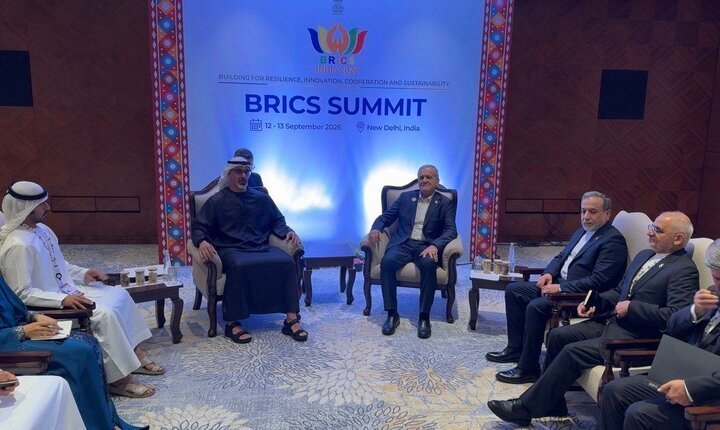
On September 12th, Iran and the UAE, along with the rest of the BRICS, signed a joint declaration which urged restraint in the Middle East and advocated for the unhindered flow of trade and energy. Apart from this, Iranian President Masoud Pezeshkian and Abu Dhabi Crown Prince Khaled bin Mohamed Al Nahyan also met on the margins of the summit. This convergence between the two countries marks a shift in the Iran-UAE dynamic, which has been consistently deteriorating since the beginning of the Iran war and Iran’s retaliatory missile strikes on the Gulf nations. However, the meeting does not necessarily signal a renewed friendship between the two countries. Instead, it raises a broader question: can BRICS emerge as a platform for this kind of diplomatic engagement, given that it has been viewed primarily as an economic grouping?
Why the Iran-UAE meeting matters
Iran and UAE have a complicated relationship. They have deep economic ties, and the last decade has also seen several attempts at rapprochement. However, the two countries remain divided on key security and strategic issues. Iran views the UAE’s close ties with the United States and its recent cooperation with Israel as a threat. The Israeli-American strikes in February 2026, which killed several members of Iran’s leadership, including the Supreme Leader Ali Khamenei, prompted Iran to strike US military infrastructure in the Gulf countries, including the UAE.
The recent war has also highlighted how Iran and the UAE’s perceptions of each other have changed. For Iran, the UAE was an important intermediary for international trade, given the barrage of sanctions restricting its capacity to trade and their adverse effect on its economy. The UAE cannot ignore the country directly to its north and has made efforts towards rapprochement. However, Emirati observers have argued amid the ongoing war that these efforts may have been in vain, with ties between Iran and the UAE unlikely to be mended anytime soon. The war and its impact on Iran’s leadership have also changed Tehran’s perspective of the UAE. It changed from a country with which Iran could maintain an amicable relationship to ensure smooth trade, to a soft underbelly of American power projection in the Gulf. In this context, the fact that Iran and the UAE co-signed a declaration and engaged in direct talks is significant. More importantly, the engagement taking place on the margins of a BRICS summit raises a broader question about the role BRICS can play in facilitating dialogue between countries with competing strategic interests.
BRICS as a Diplomatic Platform
BRICS is conventionally viewed as an economic grouping which is focused on deepening cooperation between emerging economies and better representation of these countries in global institutions. However, BRICS has expanded significantly since its inception and has brought together countries with competing strategic interests whose economic policies align with the rest of the BRICS nations. Iran and the UAE are a clear example of this. While both countries have economic interests in maintaining relations with other BRICS members, they remain divided on several regional and security issues.
This unique grouping of countries provides a platform where countries can engage with each other without the optics of bilateral cooperation. For Iran and the UAE, this is particularly important at a time when their relations have been strained by the ongoing conflict. The meeting does not mean that their differences have been resolved, but it demonstrates that there remains space for dialogue.
In this regard, BRICS does not need to act as a formal mediator for this to be significant. Its growing membership gives it the ability to bring together countries with competing interests to the same table and provides an opportunity for diplomatic engagement.
India’s Role
India’s stake in the meeting is also worth considering, particularly because the engagement took place in New Delhi. India maintains important strategic and economic relationships with both Iran and the UAE. The UAE is one of India’s key economic partners in the Gulf, while Iran remains important to India’s connectivity and access to Central Asia, particularly through the Chabahar port. At the same time, India has a strong interest in preventing further escalation in the Gulf, given its dependence on the region for energy, trade and the movement of millions of Indians.
This places India in a relatively unique position. It has been able to maintain relations with countries that have increasingly difficult relationships with each other, while avoiding taking sides in their disputes. The BRICS summit therefore provided India with an opportunity to bring these countries into the same diplomatic space without formally positioning itself as a mediator. While there is no indication that India facilitated the Iran-UAE meeting, its ability to engage with both sides makes New Delhi a particularly useful venue for such interactions.
The Iran-UAE meeting does not signal that their strategic differences have been resolved; it shows that both sides remain willing to engage despite them. Additionally, it highlights the changing role of BRICS. As the grouping expands, it brings together countries with competing strategic interests, creating space for diplomatic engagement alongside its traditional economic role. The meeting does not establish BRICS as a formal mediator, but it shows how the grouping can provide a platform for countries to maintain dialogue when bilateral relations are strained. Its future relevance may therefore depend not only on what its members can agree on, but also on its ability to bring countries with competing interests to the same table