



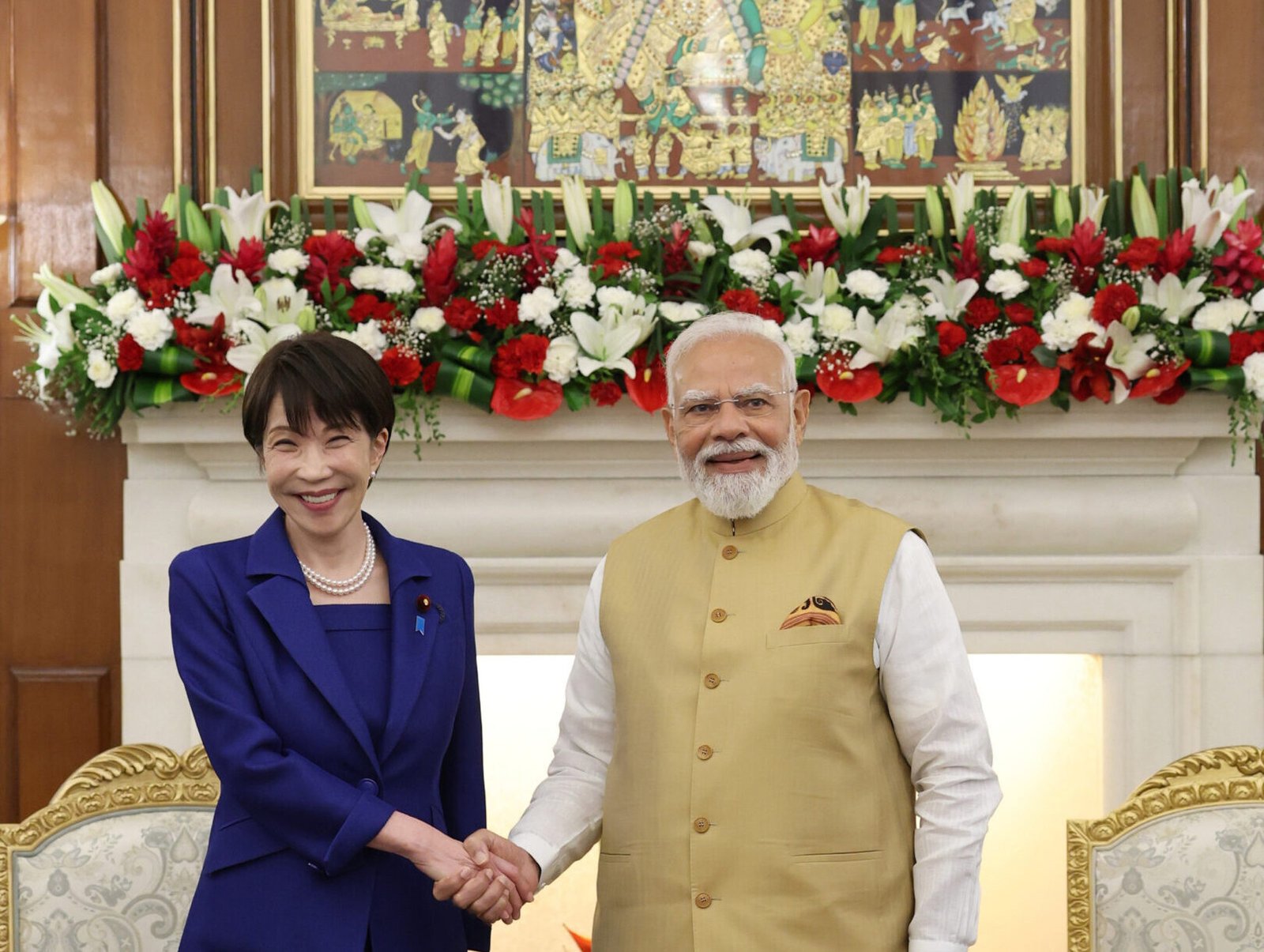
The 16th India-Japan annual summit was held from 1-3 July, 2026, in New Delhi, further enhancing the India-Japan Special Strategic and Global Partnership. A close analysis of the op-ed by Prime Minister Sanae Takaichi for The Times of India reveals a deeper depth to India-Japan cooperation through the analytical frame of “New Pan-Asianism”. The ideal of Pan-Asianism rests on the pillar of solidarity, as summarised in the 20th century slogan “Asia is One” by Okakura Tenshin. The New Pan-Asianism is characterised by autonomy and resilience. Gandhi Riyang delves into the India-Japan cooperation through this analytical lens.
The early formulation of Pan-Asianism relied on anti-imperialism, solidarity, and the creation of a unified Asian identity. In her op-ed for the Times of India, Prime Minister Sanae Takaichi highlighted th e city of Nara, with its Buddhist culture, as part of the broader historical and cultural ties between India and Japan. Such an assertion about the civilizational and spiritual connection is an expression of the classical Pan-Asianist view expounded by early thinkers. But the Pan-Asianism envisioned in response to Western imperialism soon turned sour with the Japanese staking claim to leadership of the Asian civilisation, as an actor who had mastered the civilisation of the West. Finally, the Asian solidarity envisioned under Japanese leaders turned into Japan becoming an imperialist through expansionist ambitions, proven with the annexation of Korea in 1910, and the Sino-Japanese war of 1894-95. Pan-Asianism was discredited vehemently in the aftermath of the Second World War.
New Pan-Asianism: Autonomy, Resilience and Beyond
If the collapse of Pan-Asianism is attributed to Japanese imperial ambitions, then the emerging India-Japan partnership raises a worthwhile question: Is a New Pan-Asianism emerging? The Pan-Asianism of the 20th century called for solidarity and was anti-Western imperialism, as reflected in slogans like “Asia is One”. The envisioned framework of New Pan-Asianism serves as a pragmatic model grounded in strategic autonomy and structural resilience.
The 16th India-Japan Annual Summit joint statement is clear about the regional alignment of Japan’s Free and Open Indo-Pacific (FOIP) vision with India’s IPO and MAHASAGAR frameworks. This alignment is not only understood through the language of the joint statement, it is also endorsed by Prime Minister Modi in an architecture of “Updated FOIP”. In Takaichi’s op-ed, she frames the “Updated FOIP”, unveiled in May 2026, not as a bloc-building exercise, but to ensure that no state, small or large, is “forced into choices under coercion from other states.” This convergence with India describes an open region where every nation can chart its own course in a free manner devoid of external pressure. Takaichi reads the MAHASAGAR in the same direction-treating the ocean not as an arena for hegemony, but as an area of shared commons that underpin regional stability. Both sides give us the same picture; it is not about pooling sovereignty but about preserving it.
A second, more immediate trigger for a turn towards autonomy is the American unpredictability regarding its commitment to the Indo-Pacific under the second Trump administration. There has been greater demand from Washington for burden sharing, along with tariff pressure on regional allies such as Japan and South Korea. All these contribute to distrust towards the Americans with whom there exists a decades-old alliance structure. These allies remain dependent on the security guarantee by the US. Added to this are the many withdrawals by Washington from international organisations and its public silence on questions over the defence of its allies, which have left Asian partners unsettled as they now have to adjust to the realities of America’s “America First” posture.
There is also the “double hedging” from regional players in response to the above-mentioned changes. The states in the region are balancing against Chinese assertiveness and, while doing so, hedging against American unreliability. The same point is made for India: the imposition of high tariffs, as well as the ambiguous US signalling, have pushed New Delhi toward strategic hedging and away from reliance on any single partner. Reading all these in the context of Takaichi’s op-ed adds a dimension beyond diplomatic courtesy; it indicates that both India and Japan no longer take American steadiness for granted, and this is reflected in the convergence of FOIP-IPOI-MAHASAGAR as an insurance against uncertainty.
The classical idea of Pan-Asianism is marked by cultural and civilisational appeal; what has been proposed here as New-Pan Asianism would be tested on economic and technological resilience. The two governments adopted the India-Japan Joint Declaration on Economic Security Cooperation, aimed at diversifying supply chains in semiconductors, critical minerals, ICT, clean energy and pharmaceuticals, as well as voicing concerns about economic coercion and, without naming China, the issue of arbitrary export restrictions. Furthermore, a Joint Statement on Energy Resilience and cooperation on strategic petroleum reserves extends the same logic to energy security. The Joint Statement mentions the issue of connectivity in North-East India, well reflected in Takaichi’s op-ed, which stresses Industrial Value Change linking from Assam and North-East India to Bangladesh via the Dhubri-Phulbari Bridge and Matarbari Port. These are highlighted not only as resilience-building by her but as a harbinger of prosperity.
Finally, coming to the aspect of “Beyond”, which remains hard to infer from a single summit alone, experts point to the structural obstacles to the emergence of a concrete formal alliance- the Indian non-alignment tradition, the grip of unwavering autonomy, and the asymmetry in Japanese and Indian great-power ambition- all these persist as cooperation grows stronger. The outcome of the 16th Summit, though it fell short of a defence pact, what it produced as in the words of Takaichi herself was a partnership aspiring to become “more resilient and prosperous together, building on the pillars of sectoral decorations and dialogues that ranged from AI Strategic Dialogue to the Next-Generation Mobility Partnership.
The India-Japan relationship continues to deepen, but it has not yet produced a formal alliance. The 16th Summit, through the alignment of FOIP with IPOI and MAHASAGAR, and its emphasis on economic and technological resilience, gives it a contemporary hue. What Takaichi has stated in her op-ed on autonomy for smaller states, the ocean as a commons rather than an arena, and resilience alongside prosperity now represents the Japanese approach to India. Takaichi’s use of Nara’s living Buddhist heritage paints a picture similar to what Okukura said about “Asia is one”. However, the op-ed did not put this civilisational heritage as the founding pillar. Rather, it was a pillar subordinate to concerns of security and economic cooperation that dominated both the op-ed and the Joint Statement. The new frame argued here is not about the re-incarnation of civilisational solidarity, but a pragmatic approach to overlapping interests in countering the China threat, and a growing doubt about the longevity of American commitment under the current dispensation. The India-Japan partnership, therefore, remains one marked by hedged and autonomous characteristics, which have not fully evolved into an “alliance”. The longevity of this partnership will crucially be dependent on two trajectories working alongside each other- the threat perception from Beijing and whether Washington’s Indo-Pacific commitments stabilise or continue to be fragmented.