

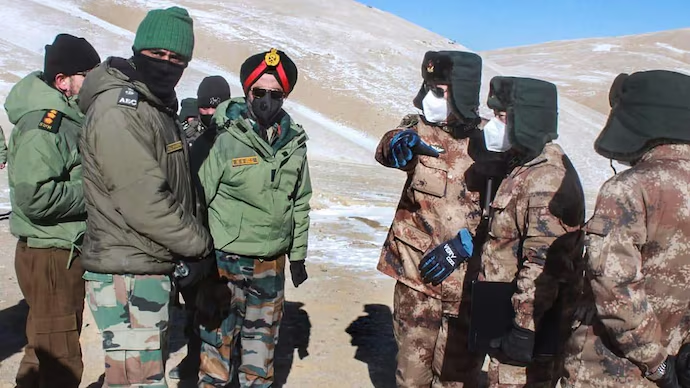
Relations between India and China are shaped by economic interdependence, efforts at cooperation, and persistent border disputes. Often, these disputes occur simultaneously with, or very close to, attempts at cooperation, reducing trust between the two. For instance, President Xi Jinping’s landmark visit to India in 2014 coincided with a standoff between the Indian Army and the People’s Liberation Army (PLA) along the Line of Actual Control (LAC), which lasted 10 days before both sides withdrew. On the Indian side, this incident led to speculation that the People’s Liberation Army may, at times, act without authorisation from the Central Military Commission, while also raising doubts about whether the border dispute can be resolved through dialogue. Nonetheless, at the end of this visit, India and China signed sixteen agreements and MoUs. This pattern of cautious yet expanding cooperation, tempered by structural and security tensions, continues to persist, as growing collaboration sits alongside increasing competition between the two countries. This competition manifests itself beyond the bilateral sphere, where we see both countries advancing their interests and competing for influence in South Asia. A case in point is Pakistan, where China’s regional influence intersects with India’s security concerns.
Pakistan: China’s Strategic Anchor in South Asia
The Pakistani army is very deeply integrated with Chinese hardware, with 81 per cent of its arms imports coming from China. Military cooperation between the two countries directly concerns India, as much of the Chinese-supplied military hardware is used against India. For example, during Operation Sindoor, the Pakistani armed forces used Chinese-made JF17 and JF10 aircraft. The prospect of interoperability between the two armed forces is also a major concern for India, as Indian defence planners highlight the possibility of a two-front war involving both Pakistan and China. Some analysts have highlighted the limits of interoperability between the two countries, attributing it to completely different command structures, language barriers and operational priorities. However, intelligence and technology sharing between the two remain a concern for India. For example, during Operation Sindoor, a Chinese vessel with advanced sensors was found operating in the Indian Ocean, pointing to larger strategic coordination.
Sino-Pakistan cooperation working against India has a long history. The aftermath of the Indo-Chinese war of 1962 saw two major alignments in South Asia: between Pakistan and China, and the USSR and India. China flagged off this new partnership by endorsing Pakistan’s claim over Pakistan-occupied Kashmir (PoK). Furthermore, the Sino-Pakistan cooperation began in Bandung (1955), when the Pakistani representative reassured his Chinese counterpart that their partnership with the United States would not be directed against China. Following the mobilisation of the Pakistan Army in response to Exercise Brasstacks (1986), several confrontations simultaneously took place between Chinese and Indian patrols in the sensitive border area of Sumordung-Chu. After 1991, India and China took multiple confidence-building measures, although they were bottlenecked by disagreements on the demarcation of the LAC. However, these measures were backtracked after Pokharan-II. After the nuclear tests, Vajpayee sent a letter to the US President Bill Clinton highlighting the Chinese threat to India’s security. The letter was released by the Americans and prompted a strong response from China. In response, China lobbied Washington to impose direct sanctions on India, proposing resolutions on Kashmir and accelerating armed shipments to Pakistan. Most importantly, China played a crucial role in aiding the Pakistani nuclear program.
Beyond military ties, China has also invested heavily in Pakistan through the China-Pakistan Economic Corridor (CPEC), a flagship project under the Belt and Road Initiative. The project aims to connect western China to Gwadar Port, giving China greater access to the Arabian Sea. It has also increased Chinese involvement in Pakistan’s infrastructure, transport and energy sectors. India opposes the project because parts of it pass through the disputed territory in Pakistan-occupied Kashmir. Therefore, CPEC has both economic and strategic implications for India.
Sri Lanka: The Contest for Maritime and Energy Influence
While Pakistan remains China’s most important partner in the region, the Chinese footprint is also visible in Sri Lanka. The island nation is strategically located near India’s southern coast and is very close to key Indian Ocean shipping routes; any Chinese presence there is bound to draw India’s attention. Chinese influence in Sri Lanka is characterised by investments in major infrastructure projects. The most visible example is China’s 99-year lease of Hambantota port. The port was constructed with Chinese financing, and its control was handed to China after Sri Lanka was unable to service its debt. However, it should be noted that the allegations of China using “debt trap” diplomacy in this case are not necessarily true. The term Debt Trap diplomacy denotes the practice of extending extensive credit to a debtor nation in hopes of securing key strategic assets when the nation cannot repay the loan. In Hambantota’s case, it was the Sri Lankan government that approached China rather than the other way around. Sri Lanka’s inability to repay the loan was also not caused by China. Lastly, the port was one of several large-scale projects promoted by Mahinda Rajapaksa as part of a corrupt and economically unsustainable development programme. However, Sri Lanka has reassured that the port will not be used by any foreign Navy, but the prospects of it being a major logistics hub for the PLA Navy in proximity to the Indian mainland are alarming.
India and China also compete for influence in Sri Lanka’s energy infrastructure. China has expanded its presence through plans for refineries and fuel distribution, adding to its earlier role in projects such as Hambantota Port. India has responded by pushing for the development of Trincomalee as an energy hub and proposing an India-Sri Lanka oil pipeline. Sri Lanka, meanwhile, has engaged both countries to secure investment and energy security while avoiding dependence on either side.
Bangladesh, Nepal and Bhutan: Competing for Influence in India’s Neighbourhood
The India-China competition also extends to smaller states in South Asia like Bhutan, Nepal and Bangladesh. China is emerging as a major trading partner and an important source of infrastructure finance and defence acquisitions for Bangladesh. At the same time, Dhaka hedges between India and China, maintaining a good relationship with Delhi due to the close economic and geographic ties between the two. However, the domestic discourse in Bangladesh harbours some anti-India narrative. In Nepal, China offers an alternative to India’s older transit routes with investments in hydropower, roads and proposed railway projects. Out of the three, Bhutan presents the most security-sensitive case as characterised by the 2017 Doklam crisis, which highlights how China’s border movements near the Doklam Plateau carry direct implications for India’s security.
China’s growing footprint in South Asia has challenged India’s traditional influence in its neighbourhood. While cooperation between India and China continues, their rivalry is being played out in the South Asia theatre.